

I have spent years watching the retail world change. Online stores have so much data about their customers. Physical store owners often feel like they are guessing. I want to change that for you today.
One of the best ways to understand your shop is to use an offline foot traffic sensor. This tool gives you the numbers you need to grow your business. It tells you how many people walk through your doors every single day. I believe every store owner should use this technology to improve their bottom line.
Mastery of your numbers sets the stage for success. If you do not count your visitors, you cannot improve your sales. I have seen small shops turn into big brands just by using data.
This guide will help you find the best pedestrian counting tools. We will look at different sensors and how they work. You will learn how to pick the right one for your specific needs. Let’s dive into the world of retail data together.
The Strategic Power of Integrating Offline Foot Traffic Sensors
Data is the lifeblood of modern retail. I always tell my clients that “what gets measured gets managed.” When you use visitor analytics, you stop guessing.
You start knowing exactly what is happening in your store. You can determine when activity is highest. You can also see which hours are your slowest. This information is gold for a store manager.
An offline foot traffic sensor helps you calculate conversion rates with precision. This is the percentage of people who buy something compared to those who enter.
If 100 people enter and only 5 buy, you have a problem. Without retail traffic monitoring, you would never know that 95 people left empty-handed. I find that this realization often shocks store owners into action.
These sensors also help with offline data collection. You can compare different store locations easily. Maybe your downtown shop has more traffic but lower sales.
Your mall shop might have less traffic but higher sales. This data guides where to allocate your marketing budget. It helps ensure a strong return on investment.
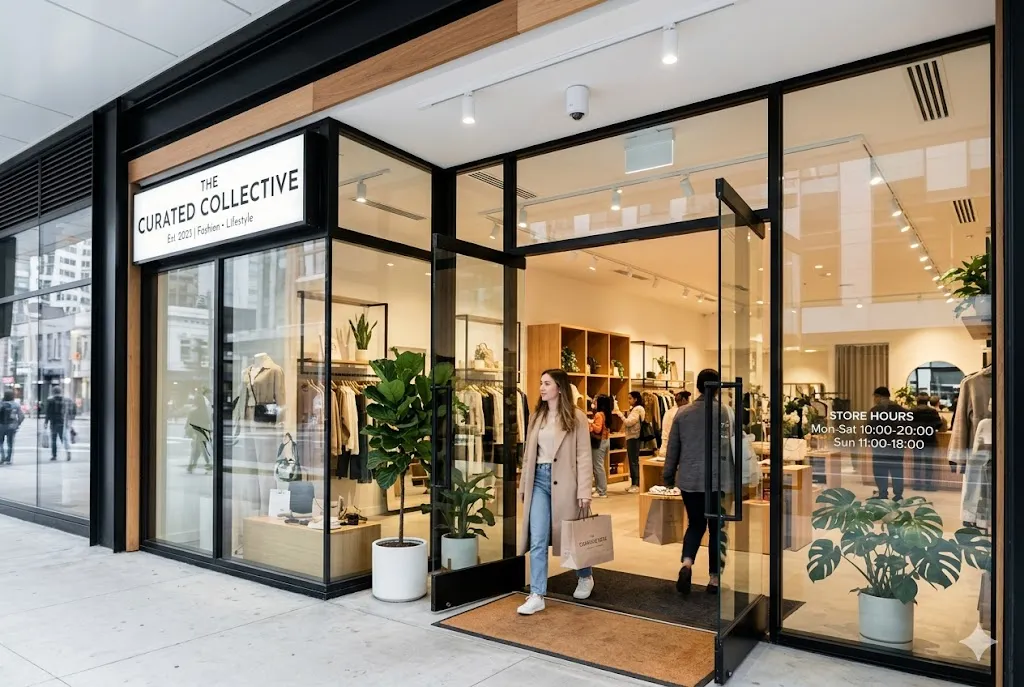
Analysis of the Top 7 Technologies for Physical Counting
Multiple methods exist for counting people. I have tested several of these systems over the years. Each one has its own pros and cons.
Here are the seven most common technologies used for store footfall analysis today.
Infrared (IR) Break-Beam Sensors
These are the simplest sensors on the market. They sit on both sides of a doorway. When someone walks through, they break an invisible beam. The device counts this as one person.
They are low-cost and simple to set up. However, they struggle with large groups. If two people walk in side-by-side, the sensor might only count one person. I suggest these for very small boutiques with narrow doors.
3D Stereo Vision AI Cameras
I think these are the gold standard for people counting technology. They use two lenses to create a 3D image. This allows the sensor to see depth and height.
It can tell the difference between a child and an adult. It can also tell the difference between a person and a shopping cart. They are very accurate, often reaching 98% or higher. These are great for high-traffic environments like malls.
Thermal Imaging Sensors
Thermal sensors detect the heat of a human body. They do not use light, so they work in total darkness. I like these because they are very private.
They do not capture faces or clothing details. They only see heat signatures. They are excellent for crowd density measurement in areas where privacy is a top concern. They are also very reliable in different lighting conditions.
Wi-Fi and Bluetooth Sniffers
These sensors pick up signals from smartphones. Most people leave their Wi-Fi and Bluetooth turned on. The sensor tracks these signals as they move through the store.
This gives you amazing behavioral analytics. You can see how long people stay in one area. You can see the path they take through your aisles. However, it only counts people with phones, so it is not 100% accurate for total counts.
Manual Digital Tally Systems
Sometimes, the simplest way is best for short-term events. A person stands at the door with a digital clicker. This is common for pop-up shops or festivals.
It is not a permanent offline foot traffic sensor solution, but it works well for one-day counts. I would not recommend this for long-term retail use. It costs too much in labor over time.
Time-of-Flight (ToF) Sensors
These sensors emit light pulses and measure how long they take to bounce back. This creates a highly accurate map of the doorway. They are compact and easy to conceal.
I find them very useful for stores that want a clean look. They handle shadows and reflections much better than basic cameras. They are a solid mid-range option for most retailers.
2D Monocular Cameras
These are basic video cameras that use software to count people. They are cheaper than 3D cameras. However, they can be tricked by shadows or patterns on the floor.
I usually suggest spending a bit more for 3D vision if you want high accuracy. If your budget is tight, 2D cameras are still better than no sensor at all.
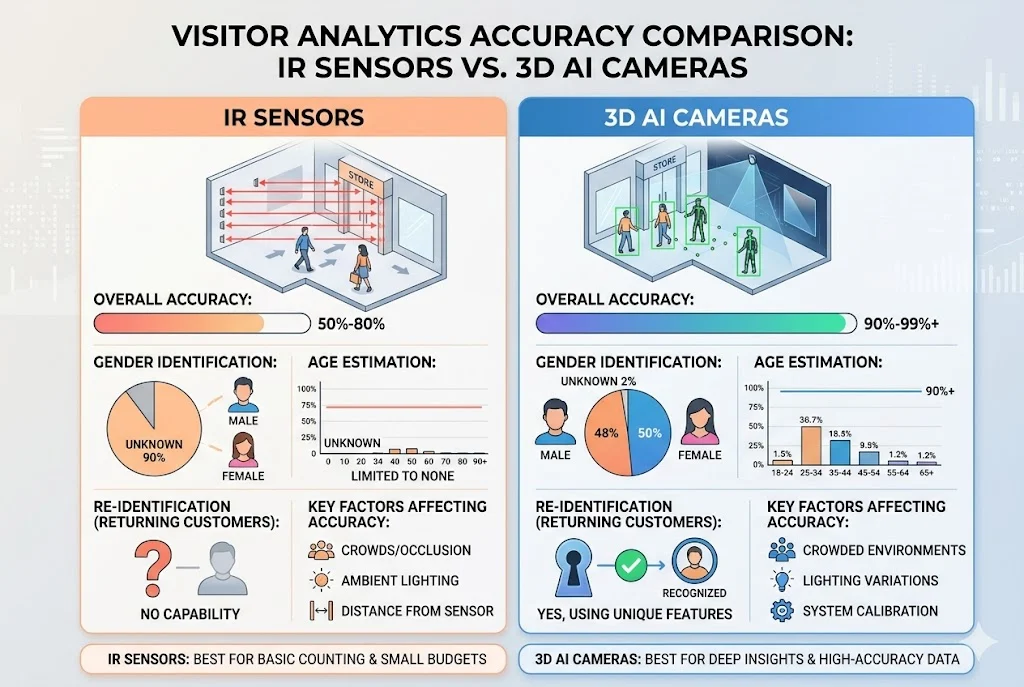
Core Technical Standards for Data Accuracy and Privacy
Choosing the right offline foot traffic sensor starts with understanding your store layout and privacy requirements. You must follow laws like GDPR and CCPA.
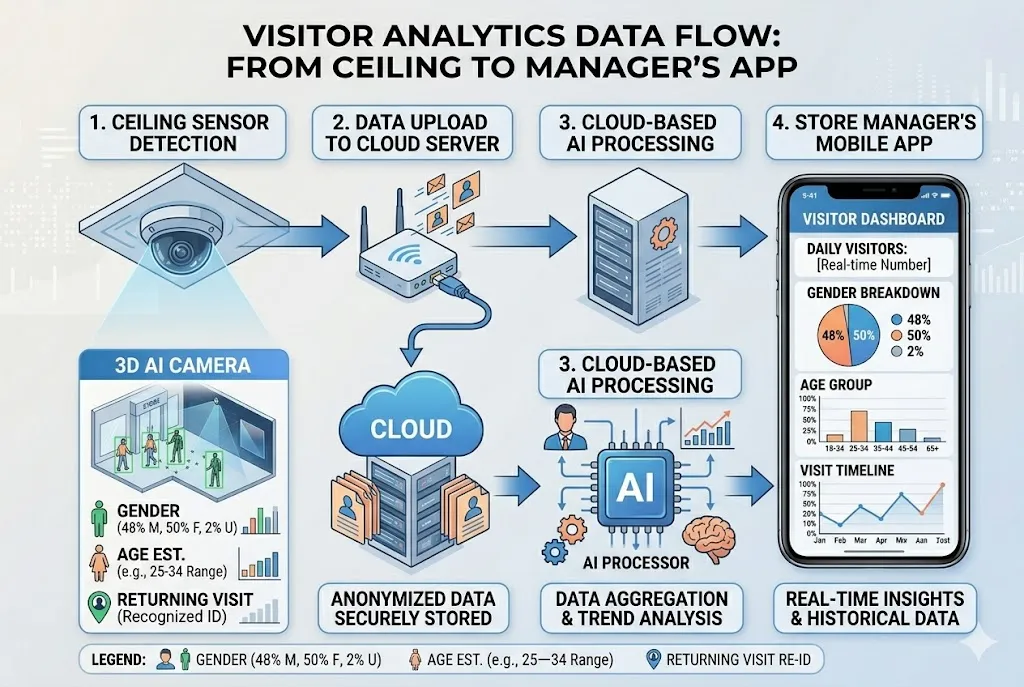
I recommend choosing sensors that use edge computing. This means the device processes all the data locally. It does not send video or images of customers to the cloud.
It only sends the final count numbers. This keeps your customers safe and your business compliant.
Accuracy is also a huge factor. You need a system that offers AI-driven staff exclusion. Your employees walk in and out of the door many times.
You do not want them to mess up your visitor analytics. Modern sensors can recognize staff by their height or by special tags. This ensures you only count real customers. It makes your sales conversion tracking much more accurate.
Height filtering is another important feature. I find that many stores want to separate adult counts from child counts. Some sensors allow you to set a height threshold.
This is helpful if children are not your primary buyers. It gives you a cleaner look at your target audience. Always ask your vendor about these technical standards before you buy.
A 4-Step Framework for Measuring Store Conversion and ROI
Sensor installation alone isn’t enough. You also need to understand how to apply the data. I use a simple four-step framework with my clients. This helps them get the most value from their retail traffic monitoring system.
Step 1: Strategic Mounting for Optimal Threshold Coverage
Every entrance in your store needs to be covered by an offline foot traffic sensor. If you miss a door, your data is wrong.
I suggest mounting sensors directly above the door. This “top-down” view is the most accurate. Make sure no signs or lights are blocking the sensor’s view. Proper mounting is the foundation of good indoor positioning sensors.
Step 2: Merging Footfall with POS Transaction Data
This is where the real transformation happens. Pairing an offline foot traffic sensor with your POS system unlocks your true conversion rate.
I believe this is the most important metric in retail. If traffic is high but sales are low, you might need better sales training. If traffic is low but sales are high, you might need more marketing to get people in the door.
Step 3: Labor Optimization and Traffic-Based Scheduling
I see many stores overstaffed on Monday mornings and understaffed on Saturday afternoons. This is a waste of money. Use your store footfall analysis to see when your peaks occur.
Schedule your best workers during the busiest times. This ensures every customer gets help. It also saves you money on labor during quiet hours. Your staff will be happier and less stressed too.
Step 4: Quantifying Marketing Lift and Window Display Impact
Did that new window display actually work? This enables a clear answer to the question. Check your traffic levels before and after you change your display.
If more people enter the store, the display is a success. You can do the same for local ads or social media posts. This helps you stop wasting money on marketing that does not drive offline data collection growth.
Tailoring Sensor Selection to Specific Operational Use Cases
Not every store needs the same technology. I tailor my advice based on the size of the business. A small boutique has different needs than a massive mall.
Before buying an offline foot traffic sensor, always check accuracy benchmarks from the vendor. You must choose the tool that fits your daily operations.
| Business Type | Recommended Technology |
Primary Goal |
| Small Boutiques | IR or 2D Sensors | Basic daily counts |
| Enterprise Retailers | 3D Stereo Vision | High accuracy & conversion |
| Shopping Malls | Wi-Fi + Thermal | Path tracking & density |
| Public Institutions | Thermal or ToF | Safety & crowd control |
Large-scale enterprises need robust systems. They often manage hundreds of locations from one office. They need a cloud dashboard to see all the data at once.
Government buildings use these for crowd density measurement. They need to ensure buildings do not get too crowded for fire safety. Always consider your specific goals before you invest in people counting technology.
Critical FAQ: Evaluating Costs, Connectivity, and Operational Risks
I hear many questions from store owners about these systems. Here are the most common things people ask me before buying.
Do these sensors require a monthly software subscription?
It depends on the brand. Some companies sell you the hardware for a flat fee. Others charge a monthly fee for the analytics dashboard.
I find that the monthly fees are usually worth it. They provide updates and keep your data secure. However, you should check your budget for these recurring costs.
What distinguishes a dedicated sensor from a standard security camera?
Security cameras are for recording video. They often have a wide angle that is bad for counting.
A dedicated offline foot traffic sensor is designed to look straight down. It uses specialized AI to count people. Most security cameras do not have the same level of accuracy for pedestrian counting.
Are battery-operated models as reliable as PoE systems?
Power over Ethernet (PoE) is always my first choice. It is very stable and never runs out of power. Battery models are easier to install because you don’t need wires.
However, you must remember to change the batteries. If the battery dies, you lose data. For long-term use, go with a wired system if you can.
Conclusion: The Future of Your Retail Success
In conclusion, the right data can change your business forever. Businesses that use an offline foot traffic sensor consistently outperform those that guess.
I have seen how a simple offline foot traffic sensor gives owners peace of mind. You no longer have to guess why sales are up or down. The facts are readily available to you.
Whether you choose IR sensors or 3D AI cameras, the key is to start counting today. Better staffing, better marketing, and higher sales are all within your reach.
Take the first step and evaluate your store entrances. Think about your budget and your accuracy needs. Once you have your data, use the 4-step framework I shared.
You will soon see how visitor analytics can transform your shop. I wish you the best of luck on your journey to retail excellence. Remember, the most successful stores are the ones that truly understand their customers.
An offline foot traffic sensor is not a luxury but a necessity for modern retail success. Using a high-quality offline foot traffic sensor is the best way to gain that understanding.


AI Heatmap Analysis for Retail Stores: 5 Data-Driven Strategies to Maximize Revenue
6 Breakthrough Strategies to Master Store Layout Heatmap Analysis and Skyrocket Sales
15 Proven Methods on How to Consolidate Event Data Efficiently to Maximize Analytics ROI
11 Strategic Remote Store Performance Analytics Tactics to Revolutionize Retail Growth
10 Professional Secrets to Own a Strong Lead Database After Events Without Failure
9 Proven Metrics to Master Your Beauty Booth ROI Calculation and Dominate Trade Shows