

I believe that understanding your space starts with high-quality data. Installing a reliable IoT foot traffic sensor is the first step toward making better business decisions.
We live in a world where every step a customer takes can tell a story. In this guide, I will share our best tips for achieving peak accuracy in 2026. We will look at technology, deployment, and how to turn raw numbers into real profit.
The landscape of physical retail and public management is changing fast. We no longer rely on simple beam counters that miss half the crowd.
Modern digital footfall monitoring allows us to see exactly how people move and interact. Let’s dive into the strategies that will help you master these powerful tools.
1. Evaluating High-Accuracy IoT Sensing Technologies
Choosing the right hardware is the foundation of your success. We see many different technologies on the market today.
Each one has specific strengths depending on your environment. You must match the IoT foot traffic sensor technology to your specific goals for real-time visitor tracking.
1.1. AI-Stereoscopic Vision Systems
AI-stereoscopic vision systems are often the gold standard for accuracy. These devices use two separate lenses to create a 3D view.
I like to think of them as human eyes for your building. They calculate depth to distinguish between people and objects like shopping carts.
These systems excel in crowded areas. They can track multiple people even when they walk close together. This precision is vital for smart retail analytics. You get a clear picture of how many real humans enter your doors.
1.2. Privacy-First LiDAR and Time-of-Flight (ToF)
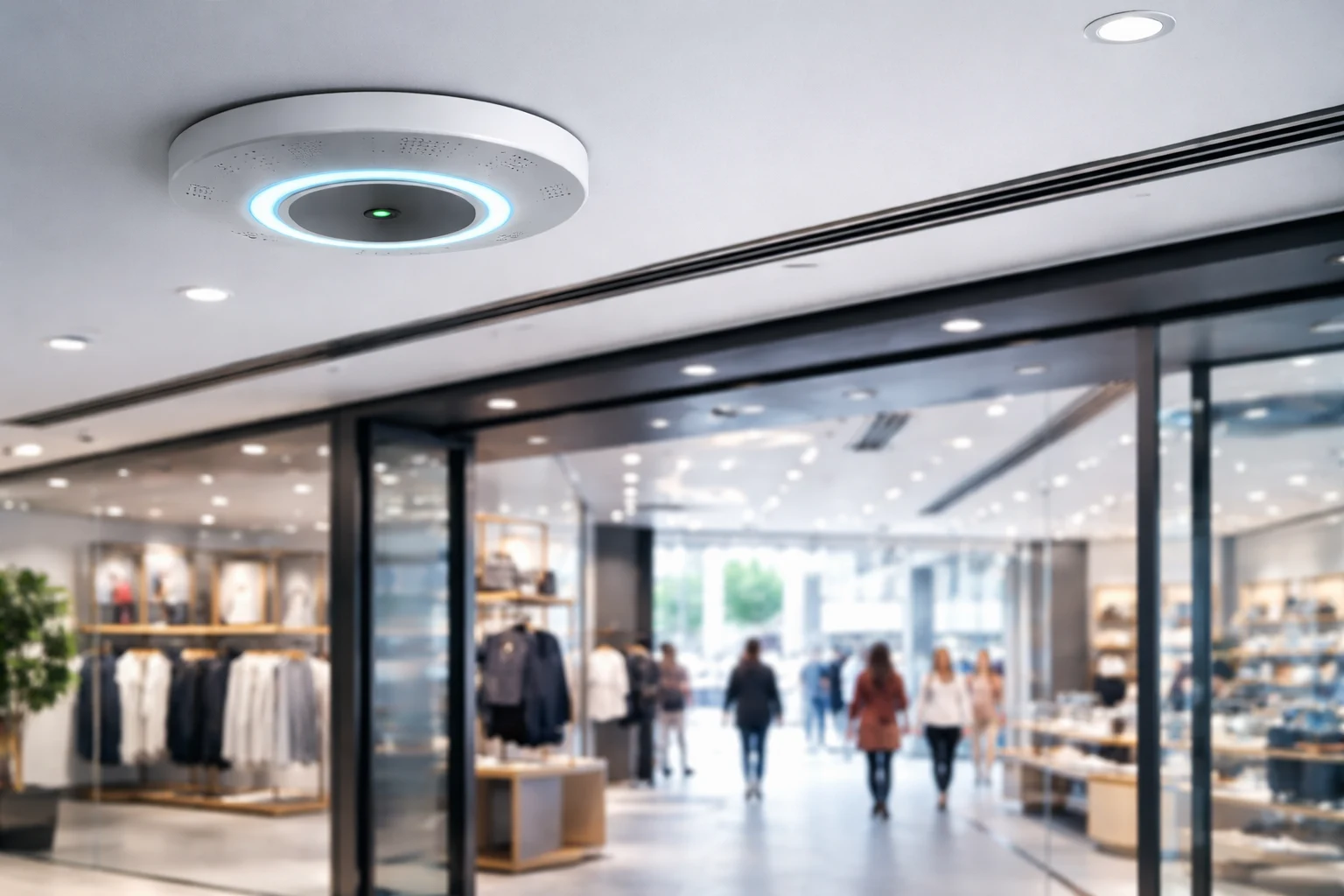
LiDAR technology is gaining huge popularity in 2026. It uses laser pulses to measure distances. This creates a highly accurate point cloud of the space.
I find LiDAR very useful because it does not capture any personal images.
Time-of-Flight (ToF) sensors operate similarly, using light signals. Both options are great for public space sensors where privacy is a top concern. They provide 99% accuracy without ever recording a face. This makes them perfect for hospitals and government offices.
1.3. Thermal Occupancy Detection
Thermal sensors detect the heat signatures of people. We often use these in areas with low lighting. They are very reliable in spots where cameras might struggle.
These sensors help with crowd density measurement without needing much power.
1.4. Next-Gen IoT Connectivity Protocols
How your sensors talk to the cloud is just as important as how they count. We have three main choices for a modern sensor network for foot traffic. Each has a different impact on your budget and setup time.
- LoRaWAN: Best for large-scale outdoor deployments. It has a long range and uses very little battery.
- Cellular NB-IoT: Great for locations without existing Wi-Fi. It offers a zero-infrastructure setup.
- Power over Ethernet (PoE): The top choice for enterprise stability. It provides both power and data through one cable.
| Connection Type | Best Use Case | Stability Level |
| LoRaWAN | Large Parks/Cities | Medium |
| NB-IoT | Remote Retail Pods | High |
| PoE | Indoor Flagship Stores | Very High |
2. Leveraging Foot Traffic Data for Maximum ROI
Collecting data is only half the battle. We need to use that data to make more money.
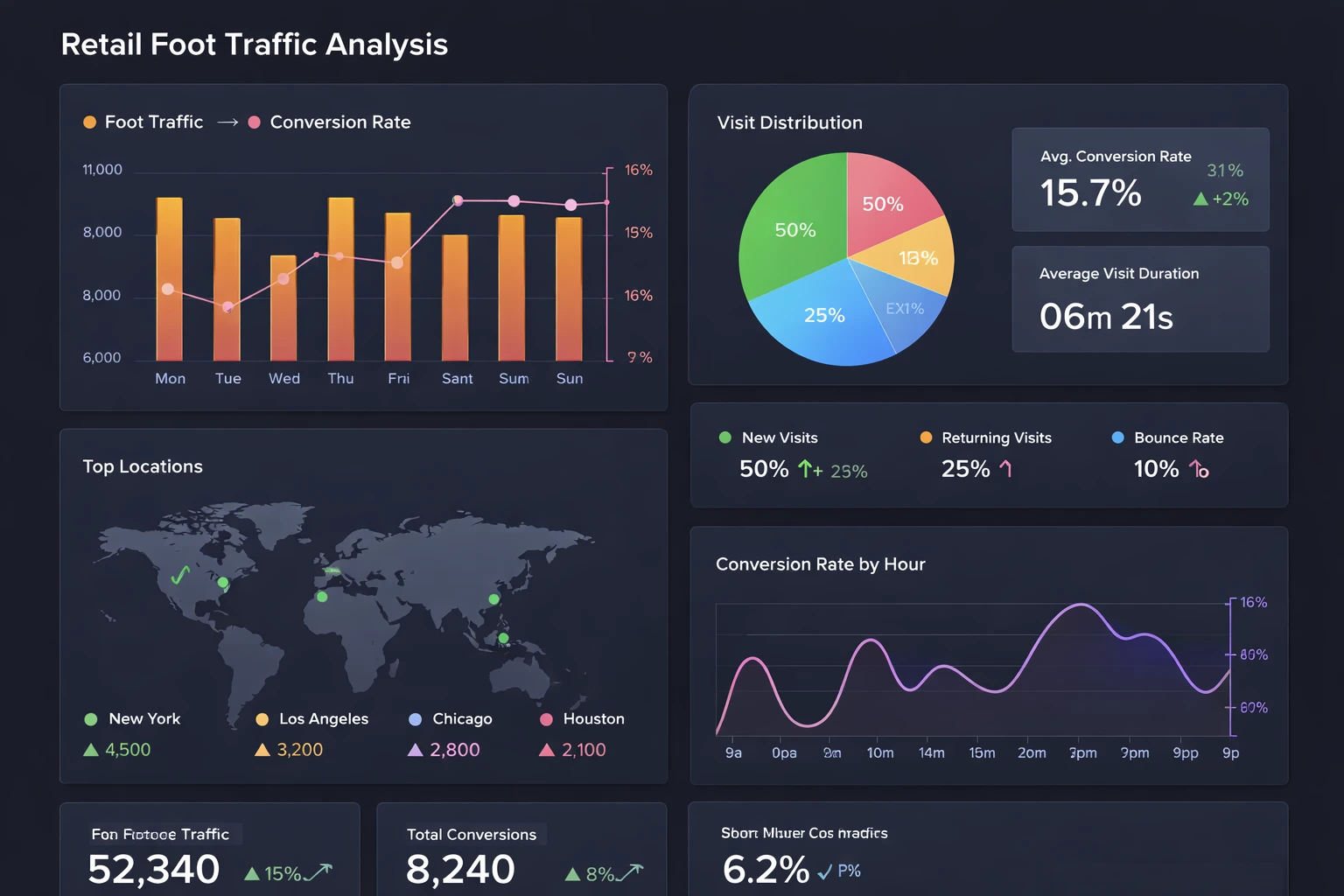
I always suggest looking at retail foot traffic analysis alongside your sales data. This reveals the “why” behind your revenue numbers.
2.1. Driving Conversion through POS Integration
Integration is the key to ROI. When you connect your IoT foot traffic sensor to your point-of-sale (POS) system, magic happens.
You can calculate your conversion rate instantly. If traffic is high but sales are low, you know there is a problem on the floor.
2.2. Labor Optimization and Smart Staffing
We use traffic data to schedule staff more effectively. Why pay five people to work when only two customers are in the store?
By analyzing peaks, we place workers exactly when they are needed. This keeps staff happy and reduces wasted payroll costs.
2.3. Reducing Overhead with Occupancy-Based HVAC
You can even save money on electricity. Many public-space sensors now communicate with building management systems.
If a room is empty, the AC turns down. This small change leads to massive savings over a full year.
3. A 5-Step Blueprint for Seamless Sensor Deployment
Success depends on a clean IoT foot traffic sensor deployment. I have seen many projects fail because of poor planning.
Deploying an IoT foot traffic sensor correctly from the start saves time and money. Follow this simple blueprint to ensure your system works from day one.
3.1. Selection Benchmarks for Scalability
Don’t just think about one store. Think about one hundred. You need multi-zone accuracy to track movement between different departments.
Also, look for API-first integration. This ensures your data can move easily between different software platforms.
3.2. Sequential Installation and Calibration
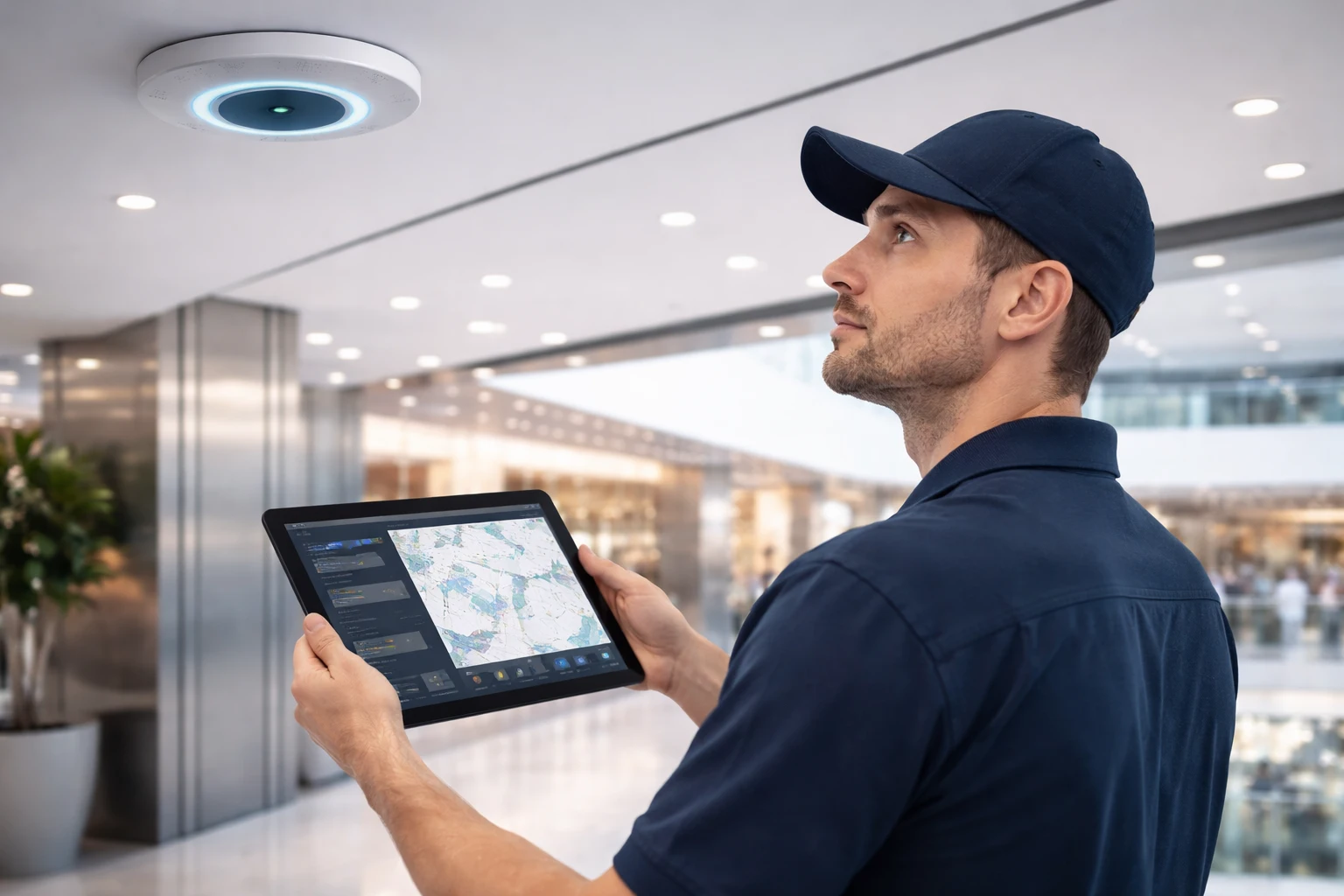
Step 1: Environmental Field of View Analysis. Check for obstructions like signs or tall displays.
Step 2: Network Security Provisioning. Ensure every device has a secure, encrypted connection.
Step 3: Ground-Truth Data Verification. We manually count people for an hour to check sensor accuracy.
4. Navigating Privacy Laws and Edge Computing Security
Security is a major topic in 2026. We must protect customer data at all costs. Using edge-based anonymous data processing is the best way to do this.
This means the IoT foot traffic sensor processes data locally. It never sends actual video or images to the cloud.
We also need to follow global laws like GDPR and CCPA. These laws are very strict about how we track people.
Always choose a visitor counting device that is “privacy by design.” Hardening your devices against cyber threats is also vital. We use regular firmware updates to keep hackers out.
5. Strategic Intelligence: Frequently Asked Implementation Questions
I get many questions about the best way to track movement. Here are the most common things people ask me during a location-based analytics setup.
5.1. Is a threshold counter or an area sensor better for my space?
Threshold counters are best for simple “in and out” tracking at doors. Area sensors are better if you want to see how people move through aisles.
If you want deep retail foot traffic analysis, choose area sensors. An IoT foot traffic sensor with area coverage gives you the most complete picture.
5.2. Do battery-powered IoT sensors provide 99% uptime?
In 2026, battery technology is very good. However, PoE is still the leader for 99% uptime.
Batteries are great for quick setups, but you must monitor their health constantly.
5.3. Which sectors benefit most from real-time pathing analytics?
Retail stores, airports, and museums rely on an IoT foot traffic sensor to manage queues and improve the guest experience.
5.4. How does LiDAR TCO compare to AI-Video systems?
LiDAR often has a higher upfront cost. However, its total cost of ownership (TCO) is lower because it requires less maintenance.
It also faces fewer legal hurdles regarding privacy.
6. Future-Proofing Your Strategy Against Emerging Risks
The world won’t stop changing. To stay ahead, we must look at AI-powered prescriptive insights.
This means the system doesn’t just tell us what happened. It tells us what to do next. It might suggest moving a display because people are ignoring a certain corner.
We also need to mitigate network vulnerabilities. Having a backup connection is a smart move. If your Wi-Fi goes down, a cellular backup keeps your data flowing. This prevents “data gaps” that can ruin your long-term reports.
Lastly, steer clear of analysis paralysis. An overload of data can slow decision-making. It is easy to get lost in too much data. Focus on three main metrics: total visits, dwell time, and conversion rate. These will give you the most value without causing a headache.
In conclusion, mastering your data is the best way to grow. I hope this guide helps you feel confident in your technology choices.
For more information on industry standards, you can check out resources like the IEEE website or the National Retail Federation. By selecting a high-quality IoT foot traffic sensor, you are investing in the future of your business. We are excited to see how you use these strategies to win in 2026!


9 Proven Metrics to Master Your Beauty Booth ROI Calculation and Dominate Trade Shows
15 Proven Methods on How to Consolidate Event Data Efficiently to Maximize Analytics ROI
7 High-Impact Strategies to Scale Revenue with Lead Capture Automation
12 Powerful Ways to Quantify Total Booth Performance After Every Event
10 Professional Secrets to Own a Strong Lead Database After Events Without Failure
10 Essential Variables for a Reliable KPI for Beauty Booth Evaluation