

Stepping into today’s competitive beauty and dermatology market means constantly seeking an edge. We all want to offer the best.
A professional skin analysis device is no longer a luxury; it’s a fundamental necessity for any serious practice. This advanced piece of beauty technology can truly transform your booth operations.
It elevates client consultations and drives significant business growth. Let’s explore why this is an essential tool.
The Strategic Advantage of a Skin Analysis Device in Your Booth
Integrating a skin analysis device into your booth offers multiple strategic benefits. Every practice that adopts a skin analysis device early gains a measurable competitive edge. It helps you stand out.
You can offer services that clients truly value. This makes your practice more appealing and professional.
Elevating Professional Consultations with High-Resolution Visual Evidence
Imagine showing your client exactly what’s happening beneath their skin. A high-resolution digital skin scanner provides this clarity.
We can use it to reveal hidden issues like sun damage or clogged pores. This visual evidence makes consultations more impactful.
It moves beyond guesswork to scientific data.
Building Client Trust and Transparency through Quantitative Dermal Data
Clients today seek transparency and results. A skin condition analyzer gives objective, quantitative dermal data.
We can measure hydration, oil levels, and pore size precisely. This data builds trust.
Clients understand their skin needs better when shown actual numbers and images. Your recommendations inspire greater confidence.
Increasing Treatment Upsells and Skincare Product Conversions
When clients see their skin issues clearly, they are more open to solutions. The data from a derma analysis tool directly supports treatment plans.
It also helps recommend specific skincare products. This leads to increased treatment upsells.
It also boosts product conversions. It is a powerful sales aid.
Top-Tier Skin Analysis Machines for Clinical and Aesthetic Environments
Choosing the right skin analysis machine is essential, as different devices serve different purposes.
We need to match the tool to our practice’s specific needs. Let’s look at some leading options.
Professional Booth-Style Imaging Systems
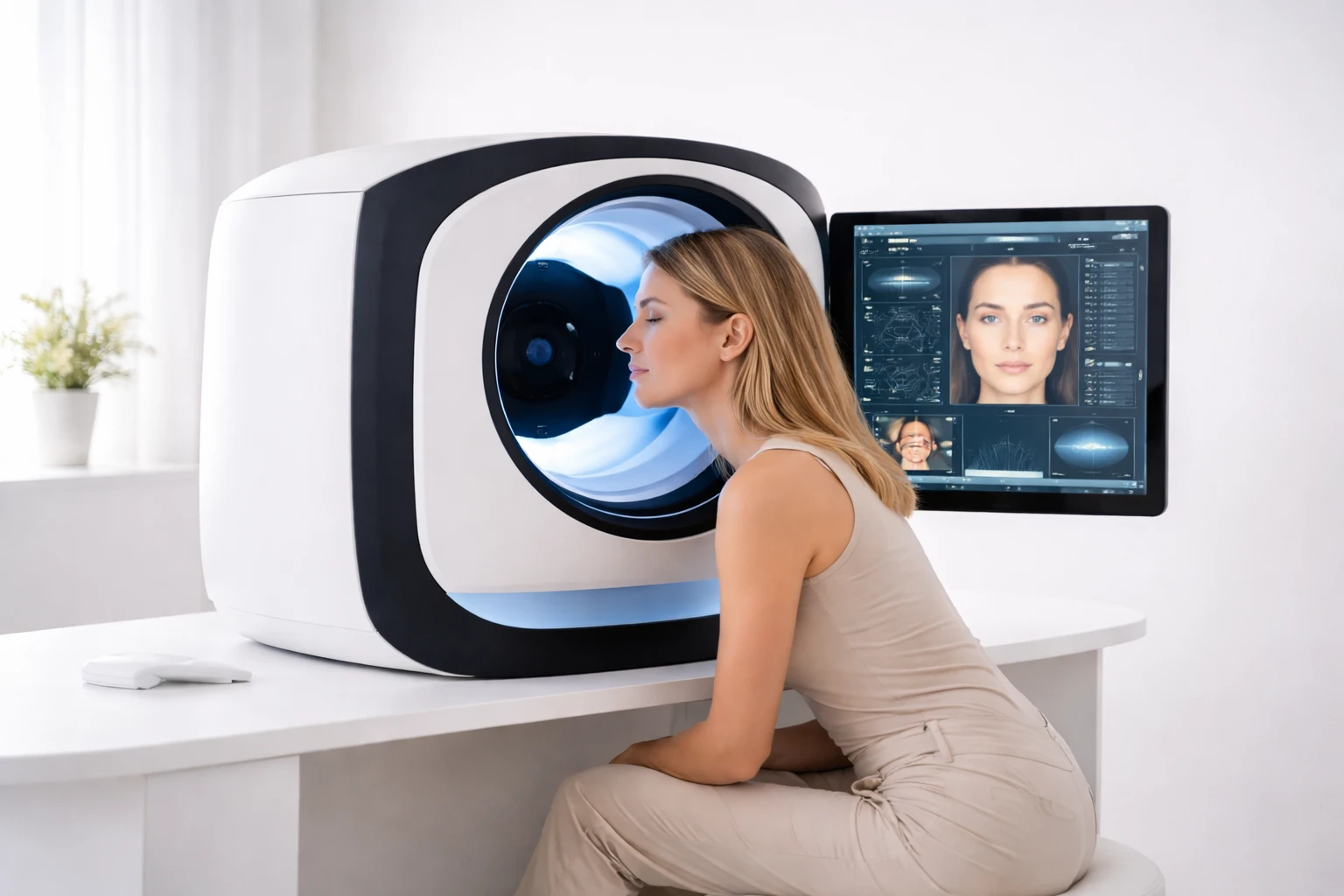
These systems offer comprehensive skin health assessment. They are designed for detailed analysis.
They typically provide high-quality imaging and in-depth reports.
Canfield VISIA: The Industry Standard for Complexion Analysis
The Canfield VISIA is widely recognized in the aesthetic world. It uses multispectral imaging to capture key surface and subsurface conditions.
These include wrinkles, spots, pores, and porphyrins. It provides an excellent baseline for treatment planning.
It also tracks progress over time.
Zemits VeraFace Pro: The Aesthetician’s Choice for User-Friendly Workflow
The Zemits VeraFace Pro offers a blend of advanced technology and ease of use. It’s ideal for busy aesthetic clinics.
This device simplifies the analysis process. It delivers quick, accurate results, making it perfect for daily use.
Meicet Multispectral Skin Analysis Device for Med-Spas
The Meicet device uses multispectral technology. It assesses various skin layers.
It helps identify issues like pigmentation, texture, and vascular conditions. Med-spas find its detailed reports very valuable for customized treatments.
Specialized Diagnostic Systems for Medical Research
For more specific medical or research applications, certain devices stand out. These often focus on precise measurements and deep diagnostic capabilities.
They are specialized dermatology equipment.
Courage-Khazaka: The Global Benchmark for Skin Parameter Measurement
Courage-Khazaka systems are highly respected for their accuracy. They measure specific skin parameters.
These include hydration, sebum, elasticity, and pH. Researchers and dermatologists often rely on their precise data.
Sylton Observ: 360-Degree Face Mapping for Advanced Pathologies
The Sylton Observ offers a unique 360-degree view of the face. It uses different light modes to reveal various skin layers.
This helps in diagnosing advanced pathologies. It also aids in detailed skin aging evaluation.
Comparing Professional Machines with Portable Analysis Tools
While booth-style machines are powerful, portable tools also have a place. Understanding the difference helps you decide which type of skin analysis device fits your workflow best.
This helps us choose the best tool for our unique situation.
Handheld Sensors vs. Stationary Skin Analysis Machines
Handheld devices are convenient and flexible to use. Stationary machines provide comprehensive data.
Both have their strengths. We need to weigh these factors carefully.
Digital Dermatoscopes and Pocket-Sized Magnifiers
Digital dermatoscopes offer magnified views of skin lesions. They are great for quick, focused inspections.
Pocket-sized magnifiers are simple tools. They allow basic visual checks.
They are good for initial screenings or small practices.
Handheld Bio-Impedance Moisture and Oil Sensors
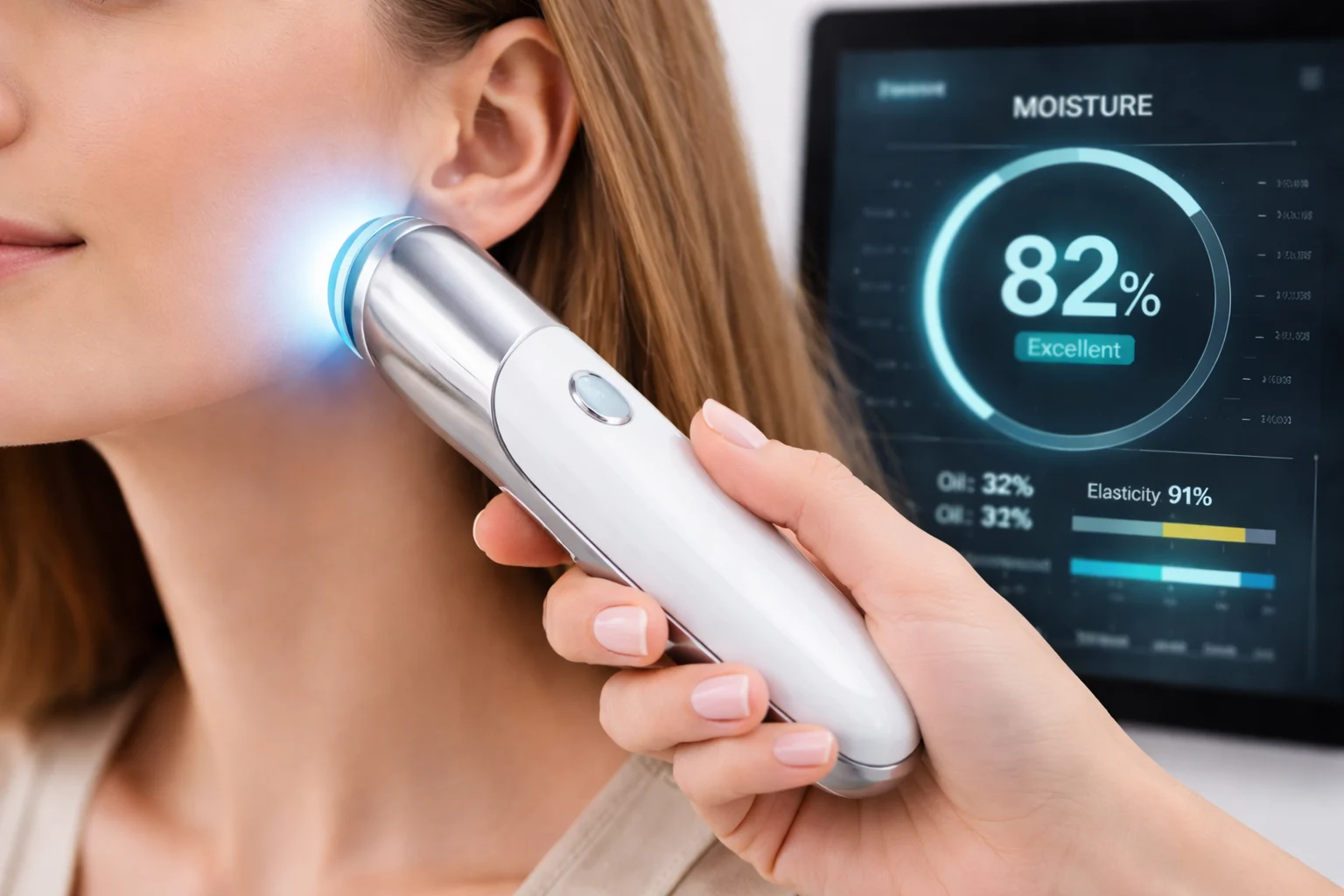
These small devices offer quick skin moisture measurement. They also check oil levels.
They are portable, easy to use, and ideal for on-the-go consultations. They are ideal for on-the-go consultations.
However, they provide less comprehensive data than larger machines.
The Evolution of Mobile AI and Tablet-Based Solutions
Technology keeps advancing. Mobile AI and tablet-based solutions are becoming more sophisticated.
They blend portability with advanced analysis. This beauty technology is quite exciting.
iPad-Integrated Skin Scanners for Boutique Consulting
Some systems connect directly to an iPad. They offer detailed skin analysis on a portable platform.
These are excellent for boutique consulting. They provide professional results without needing a large booth setup.
Consumer-Grade Smart Mirrors and Smartphone Attachments
Smart mirrors and smartphone attachments target the consumer market. They offer basic skin analysis at home.
While useful for personal tracking, they lack the accuracy and depth of professional devices. We must distinguish between these and professional tools.
Selection Criteria: Choosing the Right Skin Analysis Device for Your Practice
Choosing the right skin analysis device requires careful thought. We must consider several key factors.
This ensures our investment meets our practice’s needs. We want to make a smart choice.
Essential Optical Features for Clinical-Grade Accuracy
Accuracy is paramount for professional use. The optical features of a device directly impact its diagnostic capability.
We must look for specific imaging technologies.
The Necessity of UV, RGB, and Polarized Light Spectrums
A top-tier cosmetic diagnostics tool should use multiple light spectrums. UV light reveals sun damage and porphyrins.
RGB captures visible surface conditions. Polarized light shows vascular issues.
These combined views offer a complete picture of skin health.
Image Resolution and 3D Topographic Mapping Capabilities
High image resolution is vital for clear visualization. It allows us to see fine details like wrinkles and pores.
3D topographic mapping provides depth analysis. It helps in evaluating skin texture and volume loss.
These features enhance diagnostic precision.
Evaluating Software Utility and Business Integration
The device’s software is just as important as its hardware. Good software streamlines our workflow.
It also helps manage client data efficiently. We need tools that integrate well into our business.
Automated Report Generation and Client Progress Tracking
Automated reports save time. They provide clear, professional summaries for clients.
The ability to track client progress over time is also key. This demonstrates treatment effectiveness.
It reinforces client loyalty. An acne detection device with good tracking is especially useful.
Cloud Storage Security and CRM Compatibility
Client data security is non-negotiable. Cloud storage should be secure and compliant with privacy regulations.
CRM compatibility is also a huge plus. It helps us manage client relationships and marketing efforts effectively.
See AI’s application in beauty booths at How an AI Booth Enhances the Beauty Customer Experience
Technology Overview: How a Professional Skin Analysis Device Works
Understanding the technology behind a skin analysis device helps us appreciate its value. They use sophisticated methods to analyze skin.
This ensures precise and reliable results.
Multispectral Imaging and Deep-Tissue Fluorescence
Many advanced devices use multispectral imaging. This means they capture images using different light wavelengths.
Deep-tissue fluorescence helps visualize issues beneath the surface. It can show bacteria or inflammation not visible otherwise.
This technology is at the core of many modern analyzers.
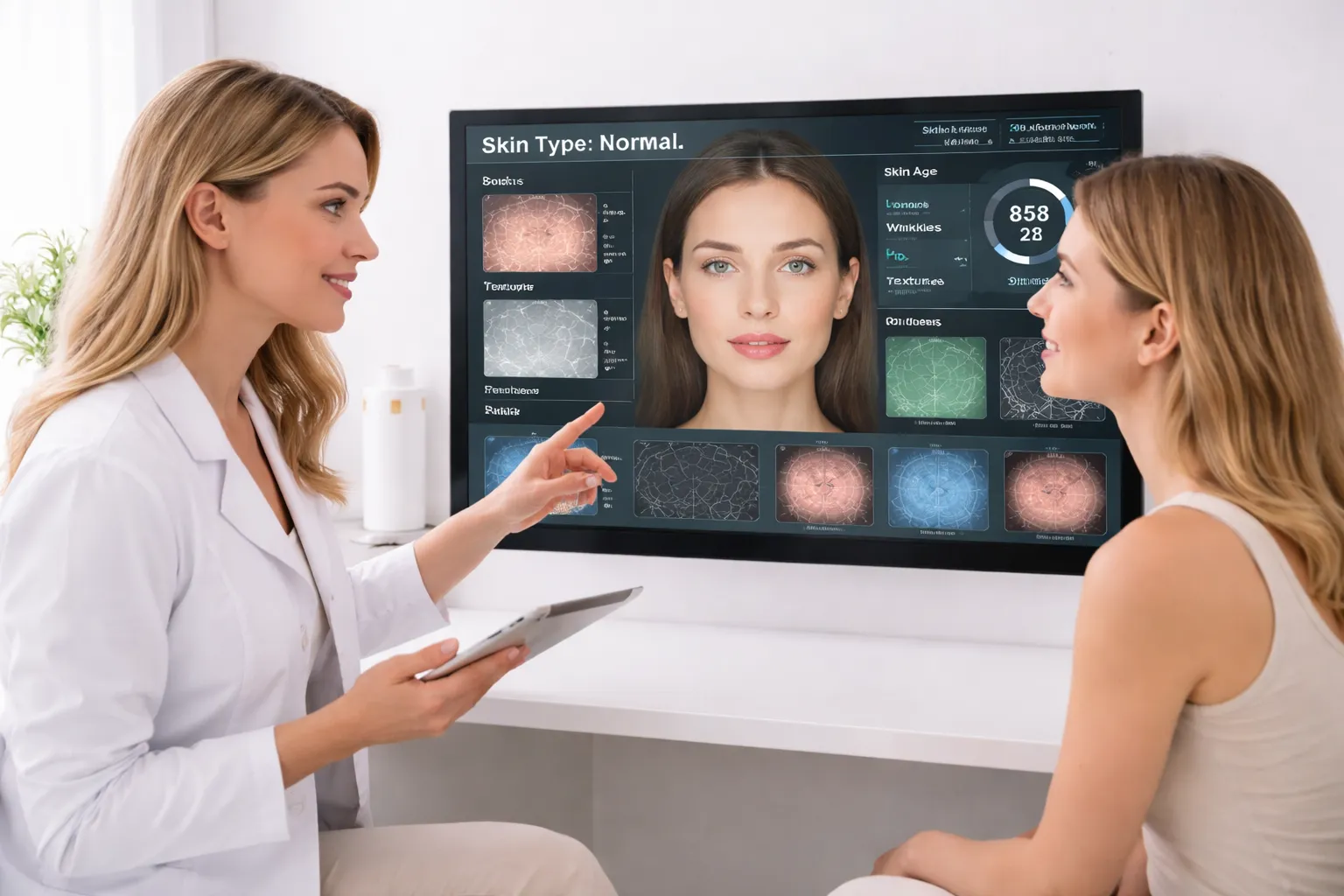
The Role of AI Algorithms in Calculating “Skin Age” and Percentile Scores
Artificial intelligence plays a big role in modern skin analysis. AI algorithms process complex image data.
They calculate metrics like “skin age.” They also provide percentile scores for various conditions.
This offers clients a clear benchmark of their skin health. It’s a powerful feature for skin aging evaluation.
Bio-Electric Impedance: Quantifying Hydration through Sensory Hardware
Bio-electric impedance is used for skin moisture measurement. It sends a small electrical current through the skin.
It then measures the resistance. This resistance directly relates to hydration levels.
This sensory hardware provides accurate, objective hydration readings.
Practical Implementation, Risks, and Professional Clarifications
Implementing a new device requires careful planning. We also need to understand potential risks.
Clear communication with clients is always important.
Optimizing the Booth Environment to Prevent Diagnostic Inconsistencies
The analysis environment impacts results. Consistent lighting and temperature are crucial.
We must ensure the booth is clean and calm. This helps prevent diagnostic inconsistencies.
A stable environment ensures accurate readings every time.
Addressing Privacy Standards: HIPAA and GDPR for Facial Data Storage
Storing facial data comes with privacy responsibilities. In the US, HIPAA guidelines are key.
In Europe, GDPR applies. We must ensure our data storage and handling practices comply with these standards.
Protecting client information is paramount.
Definitional Question: What is the difference between a skin analysis machine and a standard camera?
A standard camera captures visible light images. A skin analysis machine does much more.
It uses specialized light sources (UV, polarized) and filters. It also often integrates AI software.
This allows for deep subsurface analysis and quantitative measurements. It goes far beyond a simple photograph.
Boolean Question: Can a professional skin analysis device detect dermal malignancies?
A professional skin analysis device can highlight suspicious areas. It can show unusual pigmentation or lesions.
However, it cannot definitively diagnose dermal malignancies. Only a trained dermatologist can do this through biopsy and clinical examination.
The device is a screening tool, not a diagnostic one for cancer.
Grouping Question: Which devices are best suited for high-volume clinics vs. solo practices?
High-volume clinics benefit from booth-style imaging systems. These offer speed, comprehensive data, and advanced features.
Examples include Canfield VISIA or Zemits VeraFace Pro. Solo practices might prefer more compact or tablet-integrated solutions.
These provide portability and lower initial cost. iPad-integrated scanners are a good option here.
Comparative Question: How does the ROI of a booth-style machine compare to handheld tools?
Booth-style machines often have a higher initial cost. However, their comprehensive data and professional appearance can lead to higher ROI.
They drive more treatment upsells and client loyalty. Handheld tools have a lower entry cost.
But their ROI might be limited by a less detailed analysis. The choice depends on the scale and type of services offered.
Closing the Loop: Balancing Machine Data with the Human Expert’s Touch
While a skin analysis device provides invaluable data, it complements, not replaces, human expertise. The right skin analysis device empowers your expertise rather than replacing it. Your professional judgment remains vital.
Use the machine data to inform your decisions. Combine it with your knowledge and experience.
This holistic approach ensures the best outcomes for your clients.
Frequently Asked Questions (FAQs)
How often should I use a skin analysis device on a client?
It depends on the client’s treatment plan. For new clients, an initial scan creates a baseline.
For ongoing treatments, a scan every 3-6 months helps track progress. This shows them how much their skin has improved.
Is training required to operate a professional skin analysis device?
Yes, adequate training is crucial, with most manufacturers supplying thorough instruction.
This ensures you understand the device’s features. This also enables accurate interpretation of results.
Training maximizes your investment.
Can I integrate a skin analysis device with my existing spa software?
Many modern skin analysis devices offer API or direct integrations. A well-integrated skin analysis device can become the backbone of your client management system. Check with the device manufacturer about compatibility.
Integrating it can streamline client management and data tracking. This makes your operations smoother.


Revolutionizing Retail: How an AI Booth Enhances the Beauty Customer Experience
Using VR Demos to Showcase Product
Innovative Exhibition Engagement Solutions for High-Impact Trade Shows
8 Pro Strategies to Master How to Set Up Fast Payments at Booths and Eliminate Queues Forever
6 Key Insights into Choosing the Right Automatic Label Printer for Cosmetic Products
QR Booking System for On-site Beauty Service Reservation