

Trade show attendance is an expensive affair. You invest time and money in booth design, logistics, and traveling. The magic is when you play with your team.
Proper trade show staff training can dramatically increase your results. This guide provides a 12-point blueprint on how to make your team perform three times better at the booth.
Why Effective Trade Show Staff Training is Crucial
Your booth representatives are your company. They are in touch with potential clients first. Their talents and passion will directly influence the success of your show.
Ineffectively trained personnel may squander the chances. They may fail to see good leads or make a poor product presentation.
The skills of the exhibition staff are of the highest quality to make each interaction count. They make experiences memorable. They also transform interest into action.
It is not possible to invest in staffing methods for events. It is a requirement in order to get maximum return on investment.
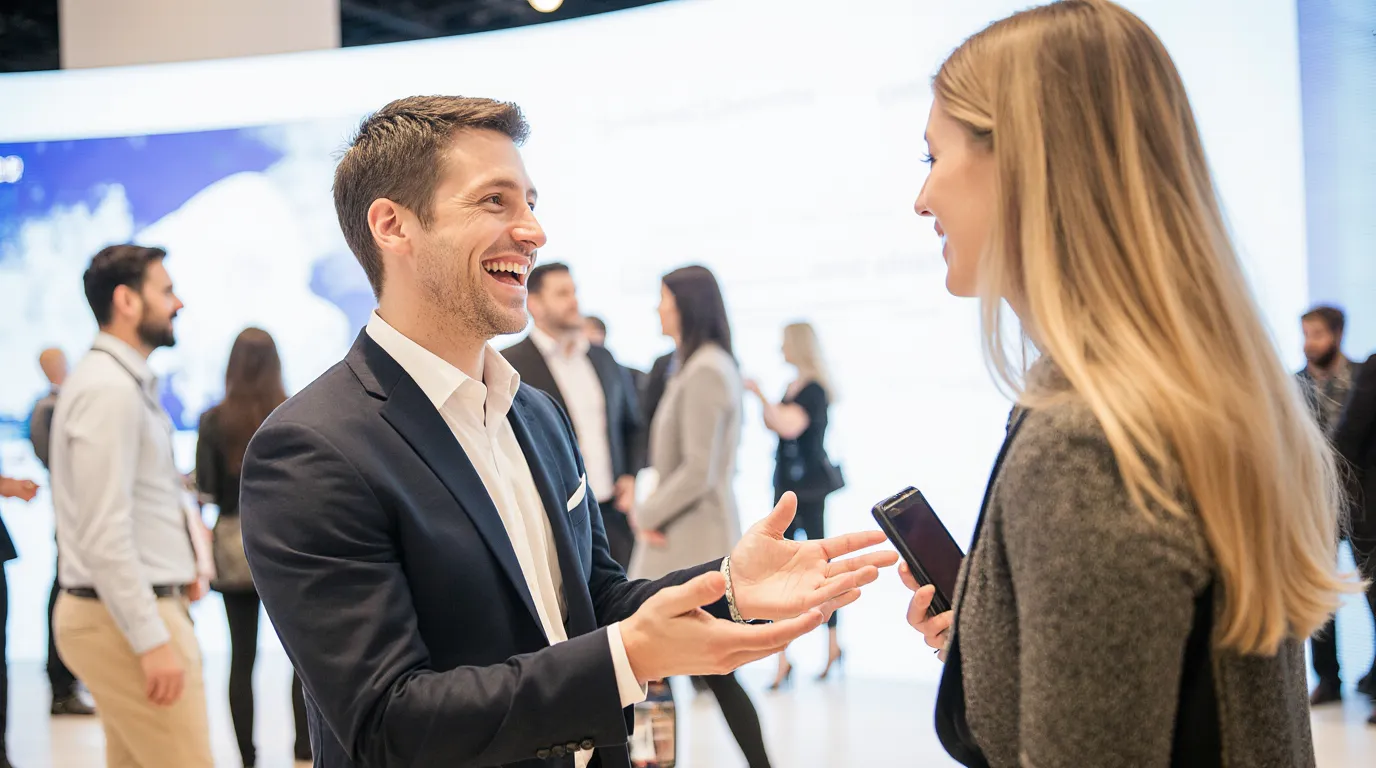
The 12-Step Blueprint for Superior Trade Show Staff Performance
Step 1: Define Goals & Assign Clear Staff Roles
Any participation in a trade show should have objectives. What do you want to achieve?
Define these goals first. This is so clear that it directs every action of yours. It assists them in concentrating their efforts on the event.
Pick Your #1 Objective (Leads, Sales, Awareness)
Decide on your main goal. Is it to gather new leads? Would you like to make sales on the spot? Or is it mainly because of brand awareness?
This is the main aim that your trade show staff training should be based on. Demonstrate to your team what success actually means.
Role Matrix: Greeter → Qualifier → Demo → Closer
Allocate roles to the individual members of the team. A “greeter” welcomes visitors. Their needs are determined by a qualifier. Products are presented by a demo specialist. A closer completes the talk or follow-up. This structure guarantees effective trade show staff training in interacting with clients.
Step 2: Build an Elite Trade Show Staff Team
Your team is your most valuable asset. Select employees who are inherently interesting and learned. A multinational team comes with numerous strengths. Bring together various areas of competence to create a force to reckon with.
Sales + Product Experts + Engineers Combo
Assemble a conglomeration of talent. Visitors are good interactors with salespeople. Product specialists are nature experts.
Engineers are capable of responding to technical queries. This integration offers full support to the visitors.
5 Traits of Top Booth Performers
Look for five key traits. These are enthusiasm, approachability, knowledge of the product, active listening, and follow-through. Such attributes render staff effective. They assist in the provision of high customer involvement strategies.
Step 3: Implement Daily Motivation Systems
Trade shows may be exhausting. Keep your team motivated. Good rewards and explicit motivators can work miracles. Motivation daily enhances energy and performance.
Leaderboards + Cash Rewards
Build a healthy competitive culture. Successful demos or tracks on a leaderboard. Give small cash rewards or bonuses to the best performers. This keeps the staff alert and keen.
5-Min Pre-Show Huddles
Begin every day with a short team meeting. Review goals and share tips. Discuss any problems from the last day. This brief discussion gets the team revitalized and establishes a good atmosphere.
Step 4: Master Booth Etiquette
First impressions are vital. Correct booth etiquette will make your team look professional at all times. It renders your booth welcoming and reachable. These norms are good for your brand.
15-Second Engagement Rule + 45° Open Stance
Train employees to approach visitors in 15 seconds. Show them the 45-degree open posture. This is an open position, non-confrontational. It promotes free flow of conversation.
Grooming = Professional Product Signal
Standards of professional appearance are absolute. Make sure that the staff is neatly groomed and dressed. The way they look is an indicator of professionalism. It is an indicator of your quality product or service.
Step 5: Craft Disruptive Opening Lines
Formulari greetings are generic greetings. Opening lines are needed by your team. These ought to get one attracted. They also need to encourage more dialogue and not terminate.
8 Battle-Tested Icebreakers (Not “How Are You?”)
Give a list of effective icebreakers. Avoid asking “How are you?” or “Can I help you?” Rather, ask questions that are related to their business or the benefits of your product. An example would be: What is your biggest challenge with X?
Qualification Questions That Filter Winners
Train employees on how to qualify leads. Assess needs and budget using questions. This will save time and concentrate energies on seriously interested prospects. It is essential in good lead generation strategies.
Step 6: Deliver Perfect Product Demos
Product demos play an important role. They highlight the value of your solution. Your team has to provide clear, concise, and powerful demos. Each demo must point out a major advantage.
30-Second Problem → Solve Framework
Conduct brief, effective demo training to train staff. Identify a common problem. Then, demonstrate how your product is the solution to it in 30 seconds. This makes demos interesting and to the point.
10x Practice Reps Minimum
Practice makes perfect. Ask employees to do their demos at least ten times. This develops trust and competence. Role-playing assists in perfecting their way of presenting their products.
Step 7: Ensure Frictionless Lead Capture
Lead information should be easy to capture. Any opposition may translate to missed opportunities. Automate the lead generation process. Keep it easy for the staff as well as attendees.
QR + NFC + Badge Scan Training
Train staff on all lead capture tools. This includes QR codes, NFC tags, and badge scanners. Ensure they know how to use each technology quickly and accurately. This boosts lead generation tactics.
No-Double-Contact Handoff Rules
Establish clear rules for lead handoffs. Ensure no prospect is contacted twice by different team members. Use a shared system for immediate updates. This prevents a confusing customer experience.
Step 8: Establish a 24-Hour Follow-Up System
The trade show is not finished just because of closing the doors. Follow-up is a prerequisite for converting leads. Timely system is professional. It keeps your company in mind for the prospects.
Hot/Warm/Cold Lead Sequences
Sort the leads according to interest level. Establish hot, warm, and cold lead follow-ups. This is to guarantee proper and prompt contact. It strengthens your sales pipeline.
Multi-Channel Touch Strategy
Engage through multiple communication platforms. This comprises email, phone calls, and social media. A multi-channel strategy enhances your probability of networking. It demonstrates your engagement and dedication.
Step 9: Conduct Scenario Training
There are numerous surprises in a trade show. Train your personnel to deal with frequent problems. Scenario training instills confidence and problem-solving in them. It enables them be able to cope with anything.
Freebie Hunters + Competitor Spies + VIPs
The interaction with the various types of visitors through role play. Training to deal with individuals who are merely seeking freebies. Train employees on ways to approach rival spies. Teach them how to treat and identify VIPs as well.
Tag-Team Rescue Protocol
Implement a “tag-team” system. In the event a staff member is having a problem with a visitor, he or she can be replaced by another. This results in a smooth handover. It eliminates embarrassing moments and ensures that it is professional.
For more insight about the Southeast Asian beauty market, visit Southeast Asia Beauty Hub
Step 10: Uphold Booth Appearance Standards
An orderly and clean booth is attractive. It shows how your brand is detail-oriented. The disorganized booths will scare away visitors. Ensure that the environment is clean during the event.
Zero Clutter + Hidden Storage
Keep the booth clean and tidy at any given time. Store personal things and surplus materials in hidden storage. A hygienic environment enables products to shine. It renders the booth more attractive.
15-Min Reset Protocol
Reduce the length of the schedule with frequent booth resets. Clean up every two hours, taking 15 minutes. This protocol assists in having a professional appearance. It makes sure your booth is always presentable.
Step 11: Manage Staff Energy Levels
The days of trade shows are very long and taxing. Staff energy can quickly dip. With the right management, you will have a fresh team. The high energy results in improved customer engagement strategies.
Break Rotations + Peak Hour Staffing
Develop a proper break schedule. Make employees have frequent rest. In addition, staff your booth strategically at the time of day when there is maximum traffic. This is to maximize the coverage during the peak of traffic to facilitate training on managing the booths.
10-Hour Day Nutrition Rules
Serve nutritious snacks and fluids. Promote healthy food among employees. Energy is maintained by proper nutrition. It makes them remain alert and concentrated during long periods.
Step 12: Step 12: 4-Week Trade Show Staff Training Timeline
Effective training requires a significant time investment. Do not rush the process. The timeline is structured to take care of everything. It enables personnel to receive knowledge and train skills.
Week 1: Goals + Product Mastery
Focus on the event objectives. Get technical and product-benefit analysis. Get familiar with all your teams and what you offer. This develops their fundamental knowledge.
Week 2-3: Role-Play + Mock Booths
Carry out a lot of role-playing. Prepare practice booths. Model different visitor conditions. This practical training instills confidence and perfects skills as the ability to develop communication skills.
Week 4: Live Run-Through
Carry out an actual live test of the booth experience. Act as though it were the real affair. This assists in smoothing out any last-minute problems. It provides a readiness to all to showtime.

Measuring Your Trade Show Success: The ROI Checklist
It is important to measure your trade show efforts. It makes you know what was working out. It also points out areas to improve. Measure your performance and improve your next plans with these measurements:
- Total qualified leads generated
- Sales conversions directly from the show
- Cost per lead (CPL)
- Booth visitor traffic count
- Average time at the booth
- Appointment conversion rate from leads
- Event-related social media mentions
- Website traffic growth following the event
- Media coverage secured
- Customer satisfaction surveys from booth interactions
- Staff performance evaluations
- Return on marketing investment (ROMI)
- Number of product demonstrations completed
- Level of engagement with interactive displays
- New partner collaborations initiated
These metrics offer a comprehensive view. They would assist you in finding out the real value of your investment. Continuously use this data to keep on bettering your staffing methods of the events.
FAQ: Trade Show Staff Training Questions Answered
What is the most important aspect of trade show staff training?
The most significant factor is practical role-playing. This builds confidence. It assists the staff in using theoretical knowledge practically. Experience makes them manage various interactions successfully.
How often should trade show staff training be conducted?
Trade show staff training needs to be done before each big show. It requires a complete orientation of new employees. It is also critical to have refresher courses for the existing team members. The frequent training maintains skills up to date.
Can small businesses benefit from detailed trade show staff training?
Absolutely. Small enterprises are not always well-endowed. These values each lead to an interaction even further.
They are maximized by detailed trade show staff training. It will make sure that they obtain the most reasonable payoff of their trade show investment.
Trade show staff training is not merely a matter of being present. It is regarding appearing ready, professional, and strong. These 12 steps enable your team to be as successful as it has ever been before.
You make each interaction with an attendee a potential win. Invest in your employees and see your booth performance shoot up in 2026 and beyond.


7 Best Ideas For Beauty Business in Vietnam (2026): Trends, Legal Entry & Strategy
Franchising a Beauty Salon: 7 Powerful Tips for Rapid Growth
How to Grow a Beauty Salon: 7 Powerful Ways to Scale Smart
How to Attract People to Your Booth: Proven Strategies for Event Success
How to Optimize Sample Distribution at Trade Shows
Automating Salon Operations: 9 Proven Ways to Boost Efficiency & Profits