
Are you dreaming of entering the booming beauty industry? Learning how to develop a skincare line and transform it into a profitable brand can seem like a monumental task, but with the right strategy, it’s absolutely achievable.
From idea validation to business growth, we support you at every stage to help your venture succeed.
This guide walks you through the key stages of product development, from formulation and branding to launching your product in the market. Let’s unlock the secrets to building a resilient and lucrative skincare business.
Why Start a Skincare Line in 2026?
Global demand for skincare is rising strongly, with the market forecast to reach $198 billion at a 6% annual growth rate.
This demand is long-lasting, as more consumers prioritize self-care, wellness, and customized beauty solutions.
Opportunities abound, especially in niche areas like clean beauty, sustainable packaging, and products tailored for specific demographics or climates.
For aspiring entrepreneurs, this fertile ground is ideal for launching a new brand. Even beginners can target healthy 20–30% profit margins, particularly by leveraging private label options in the initial stages.
Testing your ideas early helps prevent costly errors and improves profitability at launch.
Understanding the market is the first step to building a skincare line that stands out before you invest too much. You can explore more about market entry strategies here.
Validate Demand and Define Your Brand
Before mixing a single ingredient, you must validate market demand and clearly define your brand identity. Knowing how to develop a skincare line starts long before the lab — it starts with understanding your customer.
This crucial stage involves in-depth market research and a keen understanding of your potential customers. Pinpointing a niche allows you to stand out from the crowd.
Start by using tools like Google Trends to see which ingredients or solutions are gaining attention, such as “bakuchiol serum.” Additionally, conduct surveys with at least 100 potential target audience members to understand their skincare concerns and preferences.
This direct feedback is invaluable for shaping your product offerings.
A thorough competitive analysis is equally important. Evaluate existing brands in your chosen niche, identifying their pricing, unique selling propositions (USPs), and marketing strategies.
This will reveal gaps in the market that your brand can fill. If you see few halal-certified choices or limited premium natural products, that may be an opportunity to stand out.
| Aspect | Your Line (Example) | Competitor (e.g., CeraVe) | Opportunity |
| Price Point | $25 | $15 | Target premium natural segment |
| USP | Halal-certified, sustainable packaging | Basic, dermatologist-recommended | Cater to cultural fit and eco-conscious consumers |
Once you’ve identified your niche, craft a compelling brand identity. What story will your brand tell? Will it emphasize inclusivity, sustainability, or cutting-edge science?
Start with 3–5 key products — for example, a cleanser, a serum, and a moisturizer — that represent your brand and meet everyday skincare needs.
Aim for formulations with an optimal pH range of 4.5–6 to ensure effectiveness and skin compatibility.
Finally, test your minimum viable product (MVP) by pre-selling 50 units. A 10% conversion rate shows strong demand and gives you confidence to move ahead with full product development.
Refer to How to Build a Cosmetic Brand With a Low Budget for more useful tips on business development.
Formulate, Source, and Ensure Compliance
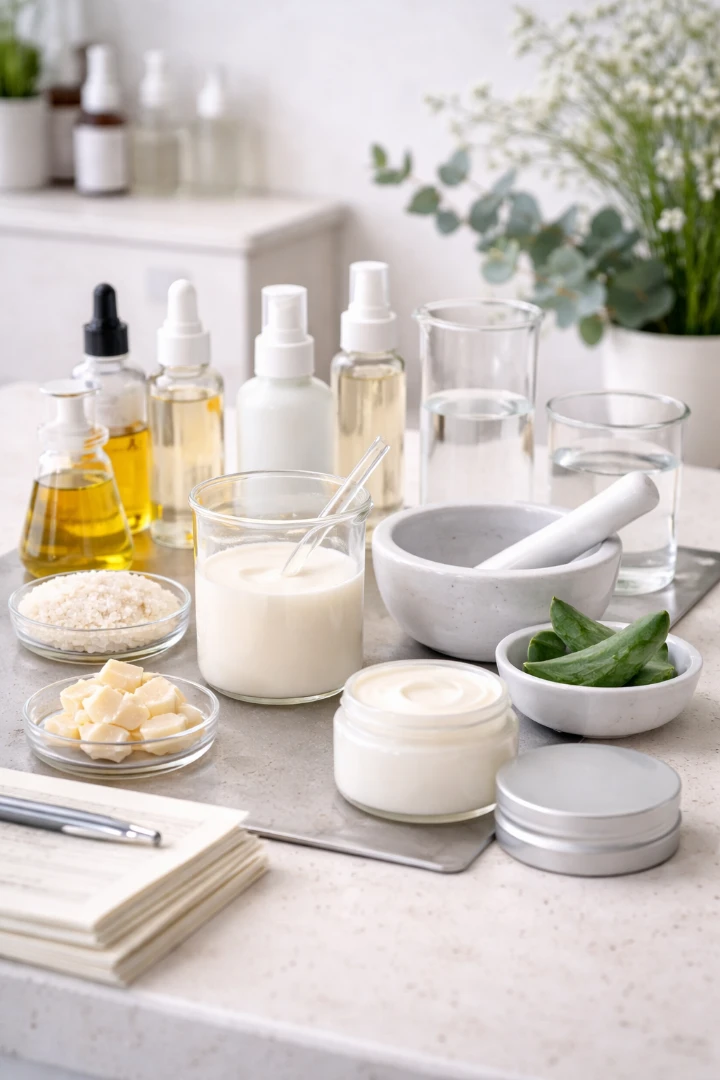
Now comes the exciting part: bringing your products to life. When learning how to develop a skincare line, you have two primary formulation paths.
The first is private label manufacturing, which is often faster and less costly. With a minimum order quantity (MOQ) as low as $2,000 and a four-week turnaround, it’s excellent for beginners.
The second path is custom formulation, which offers complete uniqueness but requires a longer timeline, typically six months.
Regardless of your chosen path, diligent ingredient sourcing is paramount. Focus on high-quality, ethically sourced components.
For instance, if you’re using niacinamide, ensure it’s at an effective concentration of 4–5%. Once you have a sample, pilot-test around 100 units to assess stability and microbial safety.
Always source from ISO 22716 certified labs, which typically charge $5–15 per unit for manufacturing.
Regulatory compliance cannot be overstated. You must comply with regulations from authorities such as the U.S. Food and Drug Administration, local Ministries of Commerce, or the EU Cosmetics Regulation.
This includes accurate INCI (International Nomenclature of Cosmetic Ingredients) labeling and avoiding unproven “cure” claims that could lead to serious legal issues.
Budget $1,000–$3,000 for trademarks, stability testing, and other legal necessities. This investment prevents costly product recalls and sets a strong foundation for your operations.
Launch Operations and Secure Funding
Launching a skincare line requires a clear understanding of your financial landscape. Creating a detailed cost analysis is a crucial step in knowing how to develop a skincare line sustainably.
| Category | Low End (Approx.) | High End (Approx.) |
| Formulation & R&D | $2,000 | $20,000 |
| Initial 500 Units Production | $5,000 | $15,000 |
| Branding & Design | $3,000 | $10,000 |
| Legal & Marketing | $5,000 | $30,000 |
| Total Estimated Cost | $15,000 | $75,000 |
Beyond the product itself, establish your legal and operational framework. Register your business, often as an LLC, which costs around $200.
Set up your e-commerce platform, with Shopify being a popular choice at $29/month, offering robust tools for online sales.
For distribution channels, direct-to-consumer (DTC) via your website is an excellent starting point.
When it comes to funding, many entrepreneurs initially bootstrap their venture using personal savings. However, consider crowdfunding platforms like Kickstarter, where raising $20,000 can support your initial production run and marketing efforts.
With a solid plan, you can realistically earn $50,000 in your first year and prepare for future growth. For more details on startup costs, check out this resource.
Brand, Package, and Manufacture
Your brand’s visual appeal and the physical product experience are critical in capturing consumer attention. This stage is where how to develop a skincare line meets how to make it truly memorable.
Invest in thoughtful packaging design that reflects your brand identity and appeals to your target audience. For example, if you’re targeting Gen Z, minimalist aesthetics with playful fonts and vibrant colors might resonate.
You can achieve professional designs cost-effectively using platforms like Canva or by hiring freelancers on Fiverr for around $500.
Beyond aesthetics, choose functional and sustainable packaging. Airless pumps preserve product integrity, while post-consumer recycled (PCR) plastics appeal to eco-conscious consumers.
Your packaging is often the first physical interaction a customer has with your brand, making it a key element of the unboxing experience.
Once your designs are finalized, move to manufacturing. After the initial pilot production of 100 units, scale up to a larger batch, such as 1,000 units. This typically takes 8–12 weeks.
During this phase, rigorous testing and validation are crucial. Implement strict quality assurance (QA) protocols to check pH levels, microbial contamination, and overall product stability.
These checks ensure product efficacy and consumer safety assessments, building trust and preventing future issues.
Market, Sell, and Scale for Profit
With your products ready, it’s time to engage your audience and drive sales. Understanding how to develop a skincare line is only half the battle — getting it in front of the right customers is the other half.
In today’s digital landscape, social media platforms like TikTok and Instagram are indispensable, especially for reaching younger demographics.
Consider micro-influencer collaborations, budgeting around $2,000 for campaigns that resonate with your niche.
Focus on key performance indicators (KPIs) to track your success. Aim for a 20% conversion rate on your website and an average order value (AOV) of $40.
Crucially, keep your customer acquisition cost (CAC) under $15. Monitor customer retention — a 30% retention rate indicates strong product appeal and loyalty.
Don’t just sell; listen. Actively solicit customer reviews and feedback, then use these insights for product iteration and continuous improvement.
This feedback loop is essential for refining your offerings and marketing messages. By consistently optimizing your approach, you can achieve significant growth, potentially reaching $100,000+ in revenue.
This strategic marketing transforms initial product development into sustained profitability and expands your distribution channels. For more marketing insights, refer to Shopify’s guide.
Frequently Asked Questions About Skincare Business Profitability
Can you profit Year 1 in a skincare business?
Yes, achieving profitability in your first year is possible, especially by focusing on private label products and a direct-to-consumer (DTC) sales model.
Aim for 20% margins after selling around 500 units to cover your initial investment and begin seeing returns.
What is CAC in skincare?
CAC stands for Customer Acquisition Cost — the total cost of marketing and sales efforts needed to acquire one new customer.
In skincare, aim to keep your CAC under $15, typically achieved through targeted social media advertising and organic content.
Which channels drive the fastest sales in skincare?
For fast sales, especially for new brands, combining TikTok Shop, Instagram Reels, and a Shopify store works very well.
Many startups leverage these platforms for rapid visibility and conversions.
DTC vs. wholesale — which profits more?
Direct-to-consumer (DTC) typically yields higher profit margins, often around 50%, because you cut out intermediaries.
Wholesale usually has lower profit per product (about 30%), but it helps you sell larger volumes faster through retail partners.
Embarking on the journey of how to develop a skincare line is an exciting venture that blends creativity with business acumen.
By diligently following these steps — from validating demand and meticulous formulation to strategic marketing and scaling — you position your brand for enduring success and profitability.
Remember, persistence, quality, and a deep understanding of your customer are the pillars of a thriving beauty business.
Anyone determined to master how to develop a skincare line will find that the rewards far outweigh the challenges. We hope this guide empowers you to transform your vision into a beloved and profitable skincare brand.


How to Create a Memorable Customer Experience at Events
Southeast Asia Beauty Hub: Navigating the 2025 Market Landscape and Vietnam’s Ascendance
Influencer Marketing for Beauty Brands: How to Get It Right
Exhibition Sales Strategy: 5 Steps to Generate High Revenue at Exhibition Booths
Vietnam Business Opportunities in 2026: Comprehensive Guide for Investors
Professional Beauty Event Guide 2025–2026: Global Calendar, Tips & ROI Playbook