
While starting a beauty business can be very exciting, the thrill can wear off very fast if you encounter legal problems. It is very important to understand the cosmetic labeling requirements. It is a very intricate world with laws from the US, Europe, and beyond.
We aim to assist you in understanding the requirements you need to comply with. This article will outline what you need to know to comply with the law. It is very important to note that proper labeling can keep you out of trouble and on the right side of the law. Let’s get your product identification just right.
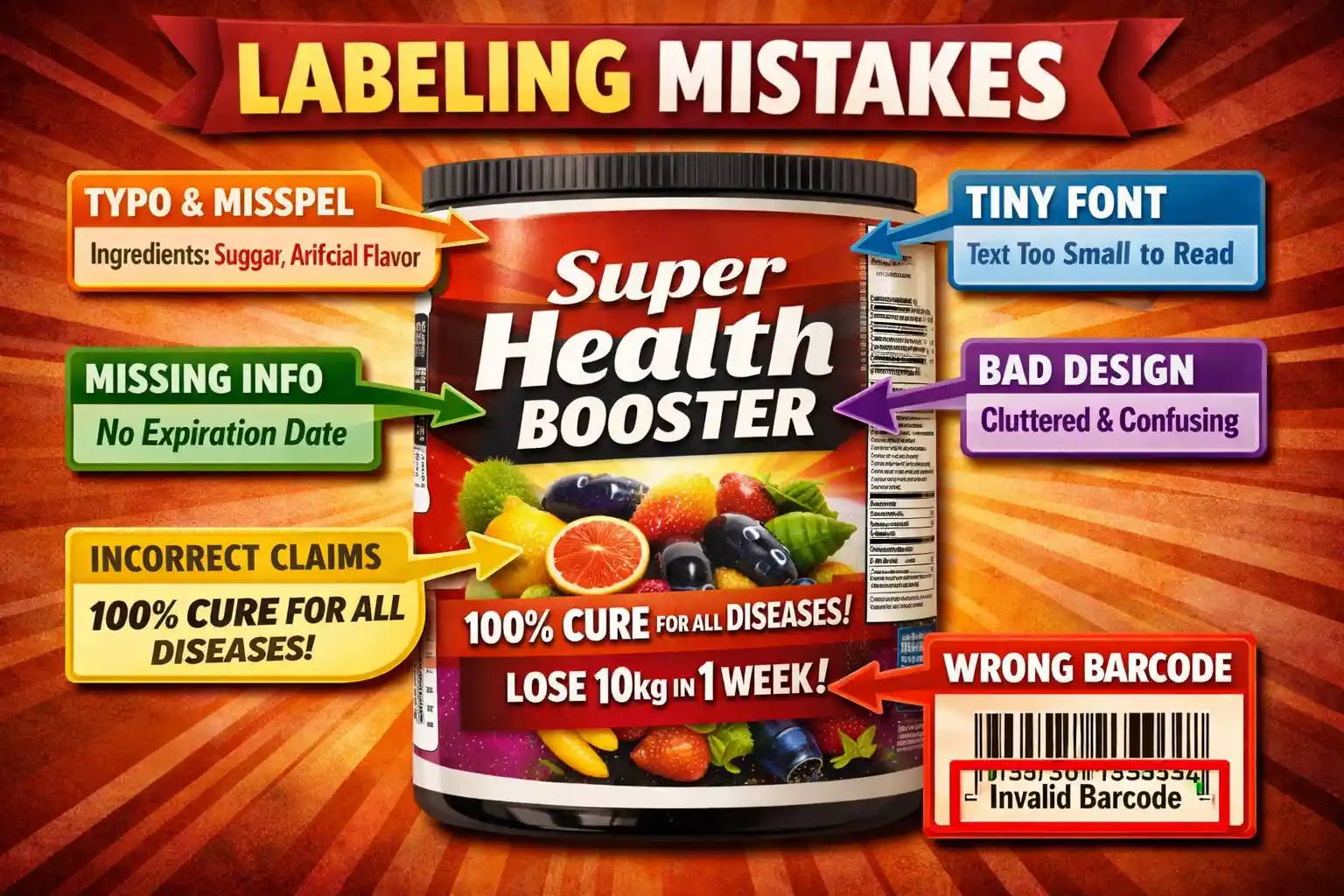
[Image: A visually striking image of a product label with sections highlighted, illustrating common labeling mistakes]
Why Cosmetic Labels Get Products Pulled — and Brands Fined
Many brands are facing challenges due to the labels. A small error can lead to major consequences. Many times, we hear of such cases where the product is being pulled. This can affect your brand’s image as well as the financial health of the business.
The FDA Warning Letter Your Supplier Never Mentioned
The FDA is very particular about the labels of cosmetic products. They send out warning letters for non-compliance. This is public information. This is done to warn the public of possible issues. Your supplier may not be aware of the regulations at times.
Most Common Labeling Mistakes That Trigger Regulatory Action
A wrong listing of ingredients is one of the major errors. Not mentioning the warnings or the manufacturer’s information is another error. Not mentioning the net contents is another error.
What “Misbranded” Actually Means Under US Law
A cosmetic product is said to be “misbranded” if the label is false or misleading. A cosmetic product is misbranded if it is absent from the required information. This may include important warnings or instructions for use. A misbranded cosmetic cannot be sold.
Who Actually Regulates Cosmetic Labels in the US
There are a number of agencies involved with cosmetic labeling requirements within the US. The main one is the FDA. However, other agencies are very important as well. Learning about each of these agencies will help you comply with regulations.
FDA Authority Under MoCRA (2022 Update You Can’t Ignore)
Well, the game has changed! The Modernization of Cosmetics Regulation Act of 2022 (MoCRA) has arrived! This new law gives the FDA more power over cosmetics. This includes new regulations on facility registration and adverse event reporting. It also includes new regulations on product identification on the label.
FTC’s Role in Claims — Where FDA Ends and FTC Begins
Another agency you’ll want to work with on cosmetic labeling requirements within the US is the Federal Trade Commission (FTC). This agency regulates the claims you make on your product labels and other advertising materials.
State-Level Rules That Override Federal Standards
While the FDA regulates the safety and proper labeling of your ingredients, the FTC regulates the claims you make about your product and your company. They want to make sure you’re not making false claims and that you have the data to support the claims you’re making.
US Cosmetic Labeling Requirements — The Complete Breakdown
The cosmetic labels being sold in the United States have to comply with certain FDA rules. These regulations specify what should be on the label as well as the place where that information ought to be found. To be sure that your product will pass the compliance standards and be legally sold on the market, it is necessary to understand all the necessary elements.
Mandatory Information and Exact Placement on the Label
There are also essential pieces of information that should be thoroughly displayed on every cosmetic label. This usually consists of the name of the product, its net content, the manufacturer/dealer information, and a full list of ingredients.
These components are not created by chance. Rather, they have to be displayed on the Principal Display Panel (PDP) or the Information Panel based on the kind of information needed.
Ingredient List Rules: INCI Names, Order, and Exemptions
The ingredients in the cosmetic should be written with the naming system that is based on the International Nomenclature of Cosmetic Ingredients. This is uniform package naming, which can be used anywhere in the global cosmetics world.
The ingredients should be provided in decreasing order of predominance, i.e., the ingredient that appears in high concentration should come first. Ingredients that have a concentration of 1% or lower can also be listed anywhere following the ingredients of higher concentration.
There are some exceptional instances where some trade secret ingredients need not be fully disclosed, yet they must be approved by the FDA.
Net Quantity of Contents: Units, Format, and Placement
The net quantity of contents shows the actual contents in the package. This information should be given in the U.S. customary units (e.g., ounces) and the metric units (e.g., milliliters or grams).
This statement should be placed on the Principal Display Panel, one that will be easily seen by the consumers when they see the product.
Responsible Person Declaration Under MoCRA
Cosmetic labels have a responsible person to be displayed on the labels as part of the Modernization of Cosmetics Regulation Act (MoCRA). This can be the manufacturer, packer, or distributor of the product.
The responsible Party has the legal responsibility of assuring the safety, compliance, and proper identification of the product. This information would be placed on the label so that when marketing their product, regulators and consumers can tell who is concerned with the product.
Warning Statements and When They’re Legally Required
There are certain warning statements that are legally mandated to be found on certain cosmetic products. Such warnings assist in making consumers aware of the dangers of certain ingredients or types of products.
To illustrate, hair dyes and products that contain some of the controlled ingredients should have warnings on them to aid in preventing abuse of the product and to protect the lives of consumers.
Principal Display Panel vs. Information Panel — What Goes Where
The Principal Display Panel (PDP) is what is seen by consumers when a product is placed on the shelf first. Usually, this panel carries the product name, net quantity of contents.
The Information Panel is normally placed on the side or the back of the packaging, and it contains more information. In this part, the ingredient list, manufacturer or distributor name, and directions of use are usually found.
EU Cosmetic Labeling Requirements — What’s Different From the US
The EU Cosmetic Regulation 1223/2009 stipulates very strict cosmetic labeling requirements in the European countries. These regulations are very different from the US regulations. The companies dealing with cosmetics need to remember such regulations in case they wish to market their products in the region. It is a common issue in the US cosmetic companies, which do not adhere to these regulations.
EU Regulation 1223/2009 — The Core Framework Explained
This is the primary cosmetic labeling law in the European region. It involves the safety evaluation, labelling, and monitoring of cosmetics in the region.
Mandatory EU Label Elements American Brands Often Miss
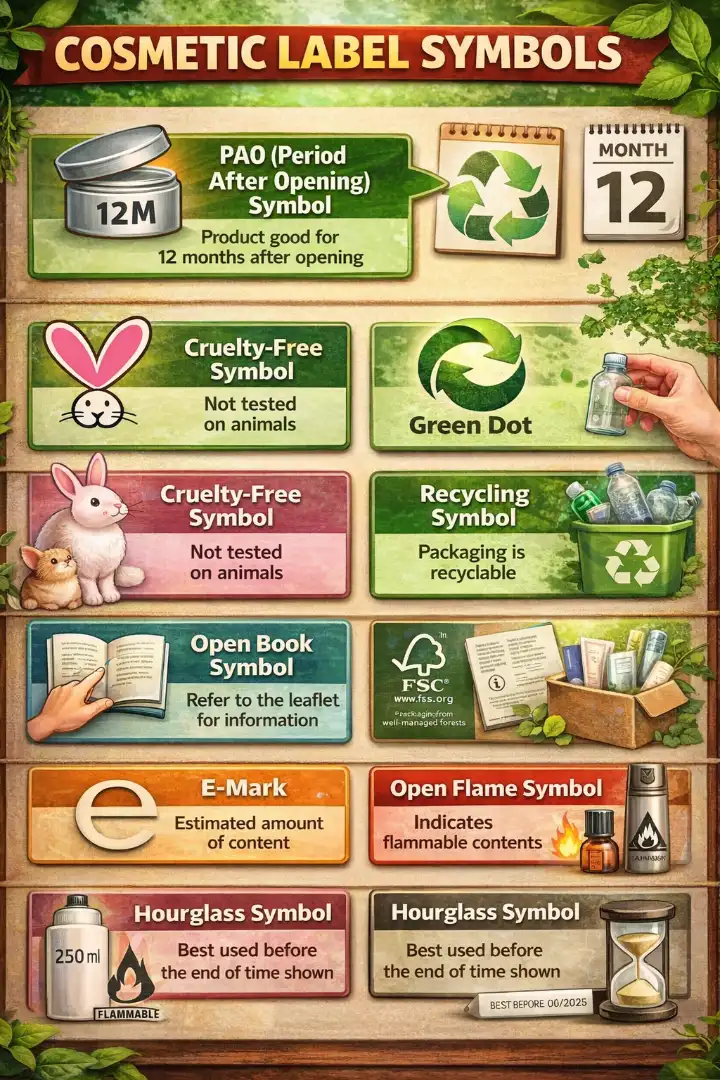
The labeling on the cosmetics in the European region should include the PAO symbol and the lowest day of its last available, the purpose of the product.
PAO Symbol, Minimum Durability Date, and Shelf Life Rules
On the packaging of the product, the PAO symbol should be positioned by the companies that produce cosmetics. This symbol should give the time before which the product is approved to continue being used once the container has been opened.
CPNP Notification and How It Ties to Your Label
The Cosmetic Product Notification Portal(CPNP) is the labeling and notification of cosmetic products in the European territory. The cosmetic companies have to add the information present on the cosmetic labeling to the CPNP platform.
[Image: A comparative infographic showing different cosmetic label symbols (e.g., PAO, Green Dot, open book symbol)]
Global Cosmetic Labeling Requirements— Key Markets Side by Side
Going global means understanding different rules and regulations in different markets. Each key market has different cosmetic labeling requirements. Some key markets will be briefly discussed.
Canada (Health Canada / INCI Requirements)
In Canada, cosmetic labeling largely follows INCI requirements for listing ingredients. Health Canada is the key regulatory body in this case. Cosmetic labels in this market must be bilingual, meaning they should be in English and French. In addition, a responsible party in Canada must be identified.
UK Post-Brexit Labeling Rules
The United Kingdom now has its set of rules following Brexit. It is similar to EU 1223/2009, but it is customized to suit the UK market. In this case, a responsible party in the UK must be identified.
China NMPA Labeling for Imported Cosmetics
In China, cosmetic labeling is a complex case. The National Medical Products Administration (NMPA) regulates cosmetic products in this market. Imported cosmetic products must be approved by this administration before they are allowed into the market. In this case, the label must be in simplified Chinese.
Australia (NICNAS/AICIS) Label Requirements
In this market, cosmetic companies are required to report their ingredients. The Australian Industrial Chemicals Introduction Scheme (AICIS) regulates industrial chemicals in this case, meaning it regulates cosmetic ingredients.
Quick Comparison Table: US vs. EU vs. UK vs. Canada vs. China
| Feature | US (FDA/MoCRA) | EU (Reg 1223/2009) | UK (Post-Brexit) | Canada (Health Canada) | China (NMPA) |
| Responsible Person | Required | Required | Required (UK) | Required (Canadian) | Required (Chinese) |
| Ingredient Names | INCI preferred | INCI mandatory | INCI mandatory | INCI mandatory | Chinese standard |
| Language | English | Local languages | English | English & French | Simplified Chinese |
| PAO Symbol | No | Yes | Yes | No | No |
| Pre-Market Approval | No (except OTC) | CPNP Notification | UK CPQ Notification | Notification | Registration/Filing |
Cosmetic Claims — Where Labels Become a Legal Liability
What the label claims can make your product to be another one. Be careful what you say. Untrue or deceptive statements carry hefty fines. They can make your product another category.
Structure/Function Claims That Accidentally Make Your Product a Drug
Is it written on your label how your product treats a disease? Then it is a drug. Does it claim to be able to cure acne or to heal eczema? Then it is a drug. Cosmetics were not able to say this.
“Natural,” “Clean,” and “Organic” — What You Can and Can’t Say
It is not clearly defined, though; these are popular terms. Be careful. The FTC is monitoring them. Ensure that you make special claims verification.
Sunscreen and Anti-Aging Claims: The OTC Drug Trap
Sunscreens are OTC drugs. Certain claims of the anti-aging products can make your product more like a drug. Careful, now there is a thin line here.
Substantiation Requirements: Backing Up What Your Label Promises
You need to prove what you say. Whatever assertion you make must be scientifically true.
Private Label and Contract Manufacturing Labeling Responsibilities
It is crucial to understand who is liable in case of private labeling or contract manufacturing. You should never take anything for granted. You must always keep in mind that the responsibility is always yours.
Who Is Legally Responsible When a Contract Manufacturer Labels Wrong
It is always the brand owner who is legally liable. You must always make sure that the product is correctly labeled. It does not matter who made the mistake. You will always be liable.
White Label Products: Your Name, Your Liability
White labeling is the term used to refer to products whose labels carry the brand owner’s name. This implies that the brand owner is liable for the product. You must always make sure that the product is correctly labeled.
What to Audit Before Your Product Ships
Before shipping your product, you should audit all aspects of the label. These include the ingredients listed, the warnings, the contact information, the net contents, and the country of origin.
How to Build a Compliant Cosmetic Label — Step-by-Step
A compliant label begins with good preparation. This involves working with professionals. It also requires knowledge of the design and legibility standards.
Gathering Required Information Before You Design
It is essential to gather all the information regarding the product before you start the design. This includes the ingredients, the manufacturing process, and the use of the product. It is important to know the markets you are targeting.
Working With a Graphic Designer Without Breaking Compliance
It is essential to educate the graphic designer regarding the compliance requirements. This includes the mandatory information, the font sizes, and the placement of the information. It is essential to provide the graphic designer with a checklist of compliance requirements.
Font Size, Language, and Legibility Requirements
The font should be clear and easy to read. Some information should be at a particular font size. It is possible that the product may be sold internationally, requiring more than one language.
Digital and QR Code Labels — What’s Allowed vs. What’s Not
The font should be clear and easy to read. Some information should be at a particular font size. It is possible that the product may be sold internationally, requiring more than one language.
Selling Across Multiple Markets — Managing Multi-Jurisdiction Labels
Selling to global markets is a complex process. You need to have a clever plan for managing your labels. This includes understanding when you should be using one label versus using multiple labels.
When One Label Can Cover Multiple Markets (and When It Can’t)
There are situations where you can successfully use a single label across different markets. For example, you can consider using a single label if you are selling in the US and Canada. However, you cannot consider using a single label if you are selling in the EU and China.
Multi-Language Label Strategy Without Violating Any Regulation
You should consider using clear and distinct language sections. You should ensure that you are including all the information in the label in each language.
How to Manage Label Version Control Across SKUs
You should consider using a version control system to manage your labels.
Common Cosmetic Labeling Violations and How to Avoid Them
It is possible for things to go wrong even with the best of plans. Knowing the common violations will therefore help you avoid them. This part will cover the common violations. It will therefore show you how to double-check your labels.
Missing or Incorrect Responsible Person Information
The inclusion of all the ingredients is essential. The proper INCI names should also be used. The two should not be negotiated under any circumstances.
Ingredient Omissions and INCI Name Errors
All ingredients should be indicated. It is also absolutely that proper INCI names should be used. Look at and determine any missing ingredients or typos.
Unapproved Colorants and Restricted Ingredient Disclosure
Only approved colorants should be used. Any restricted ingredients also need to be disclosed by you.
Sustainability Claims That Attract FTC Scrutiny
Such statements as eco-friendly or biodegradable require solid groundwork. Avoid greenwashing. Make sure that your assertions are precise and accurate.
For more insight about the beauty industry in the US, see Top Clean Beauty Product Development Companies in the US (2026 Guide)
Resources, Tools, and Professional Help for Label Compliance
You do not need to take the process by yourself. Some materials can help you. Official sources available to the government and professional consultants can offer guidance to you. Use these tools to make sure that you are done with everything.
FDA and EU Official Resources Worth Bookmarking
Various materials help in making sure that you have all the requirements so as to make sure that you are doing what is required. These are the Cosmetics Page by the FDA and the Regulation 1223/2009 (Official Journal) by the EU. Add these sources to a bookmarks list and refer to them frequently to receive an updated information stream.
When to Hire a Regulatory Consultant vs. DIY
When that is a simple product that you intend to introduce to the local market, then you are likely to do without a consultant. But in case of a complicated product or even when you are planning to introduce your product to the international market, then certainly you may want to contemplate a consultant.
Label Review Checklist Before Going to Market
Write a list of all the requirements that should be complied with before you take your product to market. This should be the list of all the aspects that you must adhere to. You would always like to have a second opinion to revise your list.
Frequently Asked Questions (FAQs)
Q1: What does “Responsible Person” mean under MoCRA?
A1: The manufacturer, packer, or distributor of the cosmetic product whose name is stated on the label is referred to as its responsible Person. This person is legally liable for the safety of the product and adherence to the FDA laws.
Q2: Do I need to list every single ingredient on my cosmetic label?
A2: Yes, you have to add nearly all the ingredients to the label of your product. This must be described in their INCI names and in decreasing priorities of dominance. itor there are very few exceptions, which principally pertain to trade secrets authorised by the FDA.
Q3: What’s the main difference between US and EU cosmetic labeling for a small brand?
A3: You will be required to designate a Responsible Person who will reside in the European Union and label the cosmetics product through the CPNP system. Moreover, you are likely to have to add such symbols as PAO Period After Opening to your label. In the US, you will have to abide by MoCRA, yet you shall not have to add the PAO label or inform the FDA via a system such as CPNP.
Conclusion
Cosmetic labeling requirements are a daunting process. It is a significant circumstance that matters to the achievement of your cosmetic brand. When protecting your cosmetic brand, it is necessary to take care of the cosmetic labeling requirements in the US, the European Union, and other world markets.
You must also take care of your customers and ensure that they are also safe with the labeling of cosmetic products in a manner that is compliant. There are changing regulatory requirements, such as MoCRA, which should be kept up to date. In case of any doubt, then refer to a professional. We will help you to come up with flawless product identification each time.


How to Create a Stunning Cosmetic Brand Color Palette for Your Business
Financial Planning for Salon Growth: 6 Proven Strategies for Big Wins
AI Consulting for Small Businesses: Is It Worth Starting in 2026?
Top Custom Cosmetic Manufacturers in Vietnam (2026 Guide)
7 Best Ideas For Beauty Business in Vietnam (2026): Trends, Legal Entry & Strategy
The Ultimate Guide to Cosmetic Formulation for Beginners