
The start of the branch with a new cosmetic product is a thrilling process that is full of artistic foresight and entrepreneurial zeal. But to ensure the cultivation of a truly shining culture that will become popular among consumers in the crowded beauty market, a carefully laid out cosmetic brand launch strategy is a must. A very beautiful product is not enough; you must have a carefully thought-out strategy to launch your product internationally. We are here to take you through the steps you really need to make an impression that is very strong impression at the first encounter to get your target market hooked.
The importance of a launch strategy
Why a strong launch strategy matters for cosmetic brands
The consumer is never left out, as he or she is bombarded with options in the busy beauty industry. The game is not as simple as selling products onto the market, but through a solid cosmetic brand launch strategy, telling the story of your brand, establishing trust, and making an unforgettable impression on your face. It creates a mood of what your brand is going to become, which plays with first sales up to customer years to come. Even the most innovative products may lose their sense of direction without a clear roadmap.
Common challenges new beauty brands face
The obstacles that are usually faced by new beauty brands include intense competition, small budgets, and the difficulty of making a mark. Winning the confidence of consumers, overcoming web-like regulations, and developing an efficient distribution chain are also very problematic. Most brands are struggling with the absence of a unique selling proposition or finding their perfect match customer, and that is the place a strong cosmetic brand launch strategy can assist on day one.
What you’ll learn in this guide
This is a full-fledged guide and, in the process, we will take you through the stages involved in a successful cosmetic brand launch strategy. You will find all doable tips and tricks, starting with identifying your target market and continuing with an epic launch day and optimizing the post-launch. We hope you will be prepared to guide your way through the world of beauty with professionalism and make an impression.
Step 1 – Identify Your Target Market and Positioning
Market research is an important thing before the formulation of any product. It is the basis of the successful cosmetic brand launch strategy to learn the current fashion in beauty, the gap in the market, and consumer analysis.
Conducting market research
A sound market research integrates quantitative and qualitative research. Research in the industry, research consumer reviews of other products, and research with your potential customers in either surveys or focus groups. This study is the basis of all the facts on which all the strategic actions that will follow are pegged.
Defining your ideal customer
Knowing your ideal customer extends past demographics and into the field of psychographics- their lifestyle and values, their buying behaviors, and problems. Having a clear understanding of who it is that you are targeting enables you to segment your products, messages, and promotional activities. A clear customer image eliminates unnecessary expenditure and lack of focus in the communication.
Analyzing competitors and industry trends
An in-depth analysis of your competitors will be priceless information. We evaluate the products that they offer, their pricing policies, their marketing policies, and reviews. What are they doing well? Where are their weaknesses? Being aware of what is happening within the industry, sustainable packaging, and clean beauty formulations are relevant to the cosmetic brand launch strategy.
Step 2 – Build a Strong Brand Identity
A brand identity is not just a logo, but it is the character and heart of your company. It is an appealing, coherent identity that can make a product into a brand that a consumer would recollect, believe in, and revisit; and it is one of the uncompromising requirements of any cosmetic brand launch strategy.
Choosing your brand name and logo
Begin with a memorable, relevant, and legally available brand name. This comes hand in hand with the aid of a professionally crafted logo that is a graphic presentation of what your brand is all about. Having your logo on all the touchpoints, packaging, website, social media, etc., therefore, as a business, investing in having your logo designed by a professional designer is a benefit in the long run.
Crafting your unique selling proposition (USP)
Your unique selling proposition states clearly enough what makes your brand better than the others and why it is different. It is the essence as to why customers would prefer you over the dozen options they have at their disposal. A good USP is distinguishing, benefit-oriented, and truly differentiated- not some simple generic statements such as high quality or natural.
Developing your brand story and voice
Developing a strong brand story and voice path is an emotional linkage with your readers. Why did you start this brand? What values do you uphold? Having a similar brand voice in all the touchpoints helps to strengthen who you are and create some recognition, which are the key results of a well-implemented cosmetic brand launch strategy.

Step 3 – Product Development & Packaging
Designing products that meet market needs
Innovation and consumer insight are essential factors in designing products that will really fulfill the needs of the market. This stage entails development, source sourcing, and intense testing, which is done to promote quality and efficacy. All the decisions made in regard to products must reflect the positioning that was made in your cosmetic brand launch strategy.
Packaging considerations and shelf appeal
The initial physical contact with your brand by a customer is often the way your brand is packaged. It must also be aesthetically pleasing, practical, sensitive where needed, and representative of your brand. A supermarket environment is full of competitors, and therefore strategic design is essential in making shelves appealing so that they come out as the winners at the point of purchase.
Ensuring compliance with regulations (GMP, FDA, MoCRA)
The non-compliance with regulations is not a matter of discussion, especially in the US. The Good Manufacturing Practices (GMP) are important in the quality and safety of the products. Cosmetics are controlled by the FDA, and violating their provisions is compulsory as far as labeling of the product, claims, and ingredient safety are concerned. We also have to think about MoCRA 2022, which provides new requirements for adverse event reporting, product registration, and facility registration, as well as safety substantiation.
Step 4 – Pre-Launch Marketing Strategy
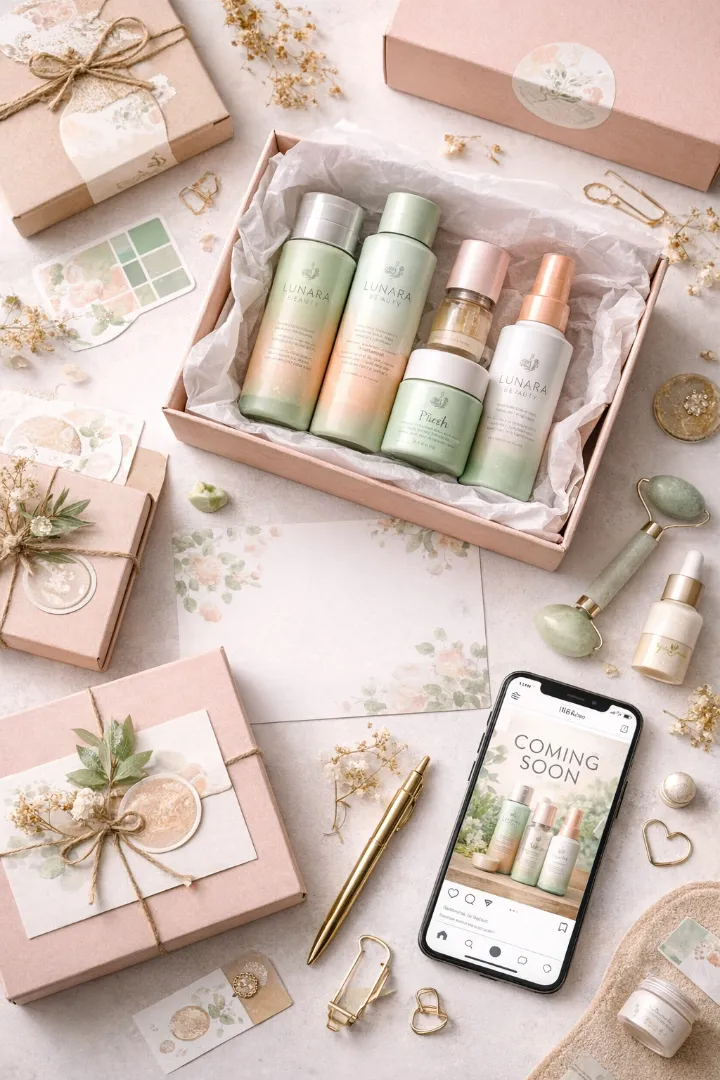
The pre-launch stage is everything to do with creating the buzz and the expectation. An effective pre-launch marketing push is probably one of the most effective elements of any given cosmetic brand launch strategy, as it establishes a ready pool of audience prior to the opening of the doors.
Building social media anticipation
Pre-launch tools such as influencer and PR seeding campaigns can help a lot. The delivery of goods to influencers and media houses will create prior reviews and endorsements for them before you officially launch. It is worthwhile to find influencers whose ability to draw in followers is more relevant to your target customer than pursuing the number of followers.
Influencer and PR seeding campaigns
Pre-launch tools such as influencer and PR seeding campaigns can help a lot. The delivery of goods to influencers and media houses will create prior reviews and endorsements for them before you officially launch. It is worthwhile to find influencers whose ability to draw in followers is more relevant to your target customer than pursuing the number of followers.
Email lists, landing pages, and early access offers
Develop email lists, develop attractive landing pages, and provide early access and the benefit of exclusive discounts in order to develop a good first audience base who are willing to make the purchase on the opening day. An email newsletter is among the most desirable things that a new brand in cosmetics can develop as an extension of its cosmetic brand launch strategy, a direct channel that allows you to reach the most interested potential clients, and these channels are under your ownership and control.
Step 5 – Launch Day Execution
The climax of all effort made is the launch day, and a perfect performance is essential. The most prominent test of your cosmetic brand launch strategy in practice is how well you perform on this day.
Online launch strategy (e-commerce, social media)
In case of online launches, make sure that your e-commerce site is well-built, user-friendly, and can handle the peak of traffic. The social media must be great with liking content, product announcements, and well-defined calls to action. Pre-test all the purchase flow elements and remove friction and technical changeover before the customers see it.
Offline launch events or pop-ups
During offline events or pop-ups, events that can be memorable can be created and result in a high level of buzz, especially in local market scenarios or a major unveiling. These physical activations will enable consumers to have a sense of your products, and this cannot be achieved by digital marketing.
Media coverage and PR outreach
Gaining media attention and further PR marketing will guarantee that your launch will reach more people, and your message will be delivered through the authority of other voices. Write press releases, contact journalists and editors who are in your niche, and have one member of your organization be available to conduct interviews and appearances on behalf of your brand.
Step 6 – Post-Launch Follow-Up
It is just the beginning. The post-go-live weeks and months will be the determinants of oscillation-inducing success of your cosmetic brand launch strategy or a loss of steam shortly after the initial spurt of visibility.
Collecting customer feedback and reviews
Proactively gathering customer feedback and reviews via surveys, turning up social media surveillance, and direct communication will provide useful information on how to improve the product, as well as making alterations in marketing. Reaction to all the reviews (good and bad) to show that your brand cares about its customers and appreciates them.
Loyalty programs and repeat purchase strategies
One way to retain a customer and create a loyal community would be to implement loyalty programs and create repeat purchasing strategies, either in the form of a subscription model or a personalized recommendation. It is much more expensive to acquire a new one compared to retaining it; therefore, post-launch retention is a high-ROI priority.
Adjusting marketing based on performance metrics
Get real-time data to know what is working and what is not. Redistribute funds to the channels and content types that yield the most successful outcomes and put on hiatus or overhaul the unsuccessful campaigns. It can greatly boost your growth curve because the ability to change fast during the post-launch period can be highly beneficial.
Step 7 – Measure Success & Optimize
In order to gain a deeper insight into the effects of your cosmetic brand launch strategy, it is necessary to monitor and analyze it carefully and honestly. Gut feelings are converted into informed decisions by data.
Key metrics to track (sales, engagement, conversions)
Monitor sales volumes, web traffic, conversion, and customer acquisition cost on social media. It is important to set baseline benchmarks before launch so that uplift can be measured accurately and which aspects resulted in significant outcomes.
Analyzing ROI for marketing channels
Return on investment analysis of different marketing media assists in determining what works and where to spend the money best. Not every channel will produce the same outcome with all brands. Your data will be able to tell you the places where you reach your audience the most and which platforms should continue to receive investments.
Iterating for future product launches
The power of a digital-first practice is that it can rely on constant iterations and modifications depending on performance metrics. Write down all the lessons that you learned during your initial launch and develop an organised debriefing. This institutional knowledge streamlines all further versions of cosmetic brand launch strategy in quicker, smarter, and more efficient ways.

Common Mistakes to Avoid
Despite the planning, traps may befall. By being aware of the most frequent mistakes, you have a chance to avoid them prior to derailing your cosmetic brand launch plan.
Launching without proper market research
Incidents of launching without adequate market research are associated with products that fail to appeal to consumers. Conjecture on the desires of your customers, however enlightened, cannot replace facts obtained by direct questioning of your target market prior to putting your money into the cutting tool.
Weak brand identity or unclear USP
It is not easy to differentiate in a saturated market with a poor brand name or an uncertain unique selling point. Consumers must be able to instantly know who you are, who you are targeting, and the reason why your product is the best one they should buy. This level of ambiguity will destroy all the other components of your launch.
Poor timing or inconsistent marketing efforts
Any momentum that you had created before launch may be lost due to bad timing or unstable marketing. A silent launch lasting several weeks, or the shift in tone and style across platforms, is an indicator of an ill-equipped brand and a loss of customer trust.
Ignoring compliance and regulations
The act of neglecting to comply and act in line with regulations is not only very risky in terms of the legal consequences, but also demeans consumer confidence and may result in expensive recalls or fines. Compliance with regulations is compulsory rather than optional as it is the minimum conformity that any cosmetic brand must complete before launching a product in the market.
For more tips on how to attract customers, see Effective Strategies for Lead Capture at Events
FAQ
How do I plan a cosmetic brand launch successfully?
To launch a successful cosmetic brand launch strategy, it is necessary to identify your target market, create a strong brand identity, create quality products that are of high quality, launch, create a strong pre-launch marketing campaign, and plan a detailed planning of the launch day. After launch, work on customer feedback and optimization.
How much does it cost to launch a new beauty brand?
The cost varies significantly based on product type, scale, marketing efforts, and distribution. It can range from thousands for a small indie brand to millions for larger enterprises. Key expenses include product development, packaging, regulatory compliance, marketing, and initial inventory.
What marketing channels work best for cosmetic launches?
The price is significantly different depending on the type of product, size, advertising and distribution. It may vary between a small indie brand and millions of dollars in large businesses. Some of the expenditures that will be key are product development, packaging, regulatory compliance, marketing, and initial inventory.
Should I use influencers for my brand launch?
Digital marketing would be extremely effective, such as social media (Instagram, TikTok, YouTube), email marketing, collaboration with influencers, and SEO. Advertising campaigns through PR and targeting are also important elements in reaching a wide audience as a strategy of launching your cosmetic brand.
When is the best time to launch a cosmetic brand?
Timing is a critical element of any cosmetic brand launch strategy. The lead-up to major gifting seasons like Christmas and Valentine’s Day, as well as spring renewal periods, often see heightened consumer interest in new beauty products. Avoid launching during highly competitive retail peaks unless you have the budget to compete for attention.
How do I measure the success of a cosmetic launch?
Measure success against the KPIs you defined before launch, including sales targets, website conversion rates, customer acquisition costs, social media engagement, and email list growth. Track these metrics consistently over the first 30, 60, and 90 days post-launch to understand trends and make informed optimization decisions.
Bringing a cosmetic brand to life demands a strategic and well-executed approach. We’ve covered every essential component of a complete cosmetic brand launch strategy: understanding your market, forging an unforgettable brand identity, developing standout compliant products, generating pre-launch buzz, executing a seamless launch, nurturing post-launch engagement, and continuously optimizing based on performance.
Ultimately, a powerful first impression in the beauty world hinges on three pillars: a meticulous cosmetic brand launch strategy that anticipates every move, an authentic and compelling brand identity that resonates deeply, and flawless execution that brings your vision to life. Don’t underestimate the power of thorough preparation and consistent effort.
The beauty industry is dynamic. Embrace a mindset of continuous learning, testing new approaches, and adapting your strategies based on consumer feedback and market trends. A great cosmetic brand launch strategy is never static — it evolves with your brand, your audience, and the market. We encourage you to test, learn, and scale your campaigns to achieve sustained success and make a lasting mark.


Influencer Marketing for Beauty Brands: How to Get It Right
Beauty and Aesthetics Conference: 5 Game-Changing Expert Takeaways You Cannot Miss
How to Build A Cosmetic Brand Logo Design That Stands Out
Southeast Asia Beauty Hub: Navigating the 2025 Market Landscape and Vietnam’s Ascendance
Beauty Booth Conversion Strategy: 35% Sales Lift
How to Develop a Skincare Line and Turn It Into a Profitable Brand