

Are you fascinated by the world of creams, lotions, and serums? Do you dream of creating your own personalized skin care products?
If so, you’ve come to the right place! This beginner-friendly guide to cosmetic formulation explains the process clearly and gives you the basic knowledge you need.
We’ll walk you through everything, from understanding basic ingredients to crafting your very first product safely and effectively.
Embarking on this journey can feel intimidating, but I promise it’s incredibly rewarding. This beginner-friendly guide to cosmetic formulation explains the process clearly and gives you the basic knowledge you need.
Let’s dive into the exciting world of making your own beauty!
What Cosmetic Formulation Means for a Beginner
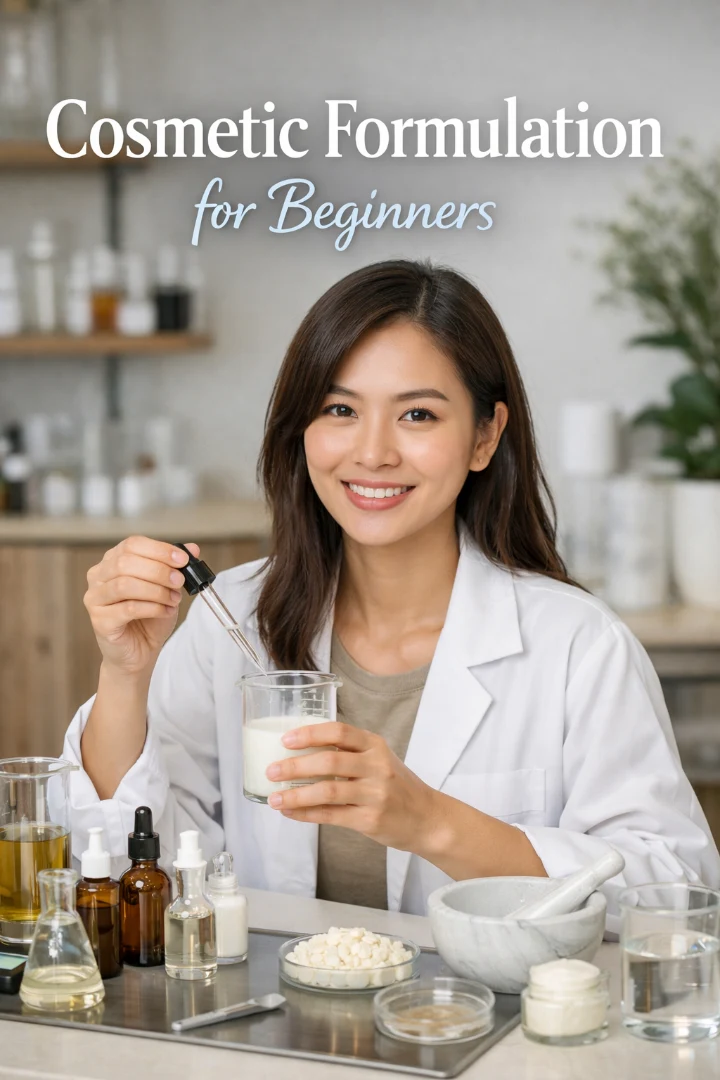
For beginners, cosmetic formulation is about learning how to mix ingredients safely and effectively.
For a beginner, this means moving beyond simply mixing store-bought ingredients. We learn how each component contributes to the final product’s texture, feel, and performance.
Formulating differs significantly from just mixing ingredients because it involves a deep understanding of chemical interactions, stability, and safety. You’re not just putting things together; you’re designing a system.
This approach ensures your creations are not only pleasant to use but also safe and long-lasting.
Beginners benefit immensely from grasping these basic principles. It allows you to transform raw materials into intentional, functional products rather than just experimental blends.
My goal with this guide is to empower you to create truly effective skin care solutions.
Cosmetic formulation begins with understanding how to combine ingredients to make safe and stable products.
This foundation is crucial for anyone serious about diving into the world of homemade cosmetics.
Core Principles All Beginners Should Know
Every cosmetic product, from simple lotions to complex serums, relies on fundamental principles. One of the first things cosmetic formulation for beginners covers is the basics of oil and water phases.
Most skin care products are emulsions, meaning they combine oil-based and water-based ingredients that typically don’t mix.
Common beginner-friendly product types include lotions, creams, scrubs, and simple serums. These products often have straightforward ingredient lists and procedures, making them excellent starting points.
We’ll focus on these as we build our knowledge base.
Crucial aspects like basic stability and cosmetic safety are non-negotiable. We must understand emulsification to keep oil and water together, pH balancing for skin compatibility, and preservation to prevent microbial contamination.
These elements ensure your products are both safe and effective for use.
Finally, developing a simple regulatory mindset is key, even for personal use. Even if you don’t plan to sell your products yet, learning about basic claims, safety rules, and legal limits is still very important.
It fosters a responsible approach to cosmetic creation.
Setting Up Your Beginner Workspace and Ingredients
Essential Equipment for a Small-Scale Lab
One of the first steps for beginners is preparing a clean, organized workspace and having the right tools ready.
You don’t need a huge lab to start. A precise digital scale (accurate to 0.01g) is essential because cosmetic formulas are based on weight percentages.
You will also need heat-resistant beakers (glass or stainless steel), a mini mixer or immersion blender for emulsifying, and a reliable thermometer.
Don’t forget spatulas for scraping, gloves for hygiene, and safety goggles. These protect you and ensure the integrity of your formulations.
Optional tools like a hot plate with a stirrer or a pH meter can be added later as you advance.
Core Ingredient Categories You’ll Use Most
Getting familiar with ingredient categories is vital for good ingredient selection. In cosmetic formulation for beginners, the most important categories to learn first are emollients, emulsifiers, and preservatives.
Emollients and oils, such as jojoba oil or shea butter, provide skin conditioning and a luxurious feel. Water and hydrosols form the base of many products and deliver hydration.
Emulsifiers are crucial for creams and lotions; they are the “glue” that holds oil and water together in a stable mixture. Preservatives are non-negotiable for any product containing water, preventing bacterial and fungal growth.
Humectants such as glycerin help attract moisture to the skin. Thickeners control the product’s thickness, while simple actives like vitamin E provide added skin benefits.
A Simple “Starter Ingredient Pack” for Beginners
To begin, I recommend a concise starter ingredient pack. You could choose 3–4 versatile oils like sweet almond, sunflower, and fractionated coconut oil.
Combine these ingredients with one or two beginner-friendly emulsifiers. Polawax or Emulsifying Wax NF are good choices because they are easy to use.
Always include a broad-spectrum preservative like Liquid Germall Plus or Phenonip to ensure cosmetic safety. Finally, add a humectant like vegetable glycerin.
This modest selection provides enough variety to create several basic formulations and practice your skills.
How to Read and Build Basic Cosmetic Formulas
Understanding a cosmetic formula is like reading a recipe. This is one of the most empowering skills in cosmetic formulation for beginners.
Most formulas are weight-based, using percentages that add up to 100%. This method ensures accuracy and makes scaling up or down much easier.
We never use water by volume in professional cosmetic formulation.
To calculate grams from percentages for a 100g batch, it’s simple: 1% equals 1 gram. So, if a formula calls for 5% of an ingredient, you’ll use 5g for a 100g batch.
For a 50g batch, you’d use 2.5g. Your digital scale will be your best friend here!
Cosmetic formulas are usually divided into three phases: the oil phase, the water phase, and the cool-down phase. The oil phase contains oil-soluble ingredients, while the water phase includes water-soluble ingredients, and both are typically heated. The cool-down phase is added last and contains heat-sensitive ingredients that are mixed in after the formula has cooled.
This structured approach ensures proper mixing and stability testing.
For more insight into business development, see How to Build a Cosmetic Brand With a Low Budget
How to Safely Modify a Simple Base Formula
Once you’re comfortable with a base formula, you can start experimenting. A key skill in cosmetic formulation for beginners is learning to swap only 1–2 ingredients at a time.
For instance, replace one oil with another, or try a different humectant. This controlled approach helps you understand the impact of each ingredient change.
Crucially, keep your emulsifiers and preservatives within their recommended usage ranges. Altering these too much can lead to emulsion breaks or inadequate preservation, compromising cosmetic safety and shelf life.
Always consult your supplier’s guidelines for safe percentages.
A Step-by-Step Beginner Lotion Recipe
Let’s put theory into practice with a simple, beginner-friendly lotion recipe. This is one of the best hands-on exercises in cosmetic formulation for beginners — you’ll learn the core principles of emulsification and preservation while creating a lovely moisturizing product.
This is a 100g batch, perfect for getting started.
Ingredient List with Exact Percentages and Grams (100g batch)
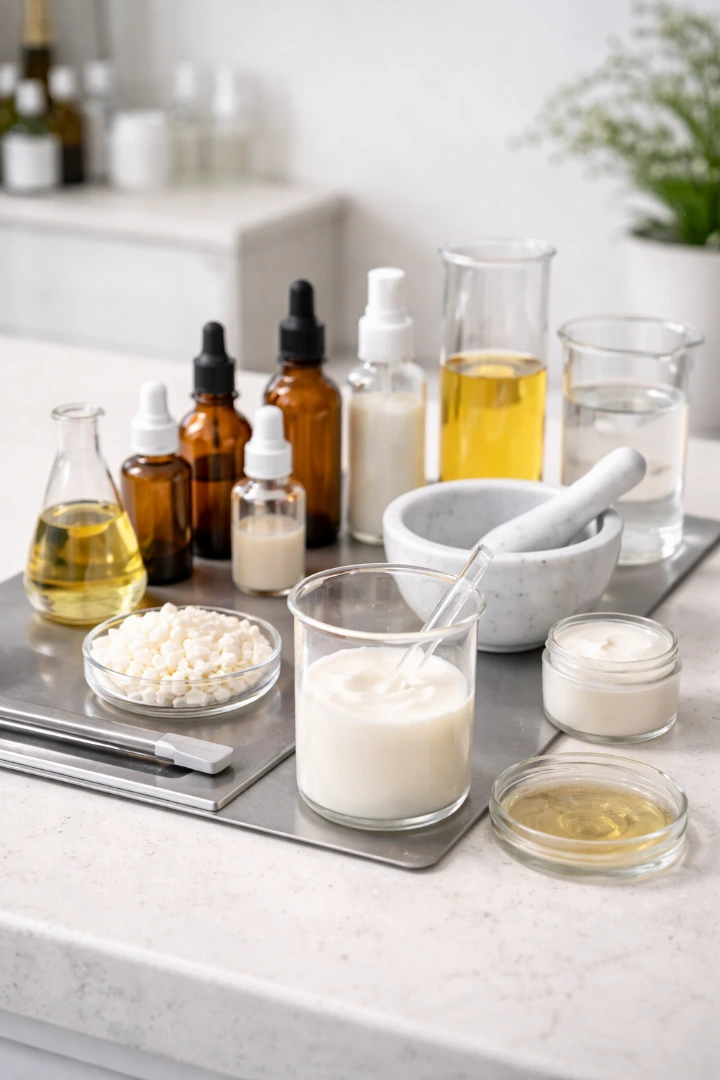
Water Phase:
- Distilled Water: 70.0g (70%)
- Vegetable Glycerin (Humectant): 3.0g (3%)
Oil Phase:
- Sweet Almond Oil (Emollient): 15.0g (15%)
- Emulsifying Wax NF (Emulsifier): 5.0g (5%)
- Stearic Acid (Thickener/Co-emulsifier): 2.0g (2%)
Cool-Down Phase (add below 45°C):
- Liquid Germall Plus (Preservative): 0.5g (0.5%)
- Vitamin E Oil (Antioxidant): 0.5g (0.5%)
- Fragrance Oil or Essential Oil (Optional): 1.0g (1%)
Step-by-Step Procedure
Prepare and Heat the Oil Phase: Combine Sweet Almond Oil, Emulsifying Wax NF, and Stearic Acid in a heat-resistant beaker. Place this beaker into a water bath (a pot of simmering water) to gently heat.
Prepare and Heat the Water Phase: In a separate heat-resistant beaker, combine Distilled Water and Vegetable Glycerin. Place this beaker into the same water bath.
Heat Until Melted: Heat both phases until the Emulsifying Wax and Stearic Acid are fully melted and the water phase reaches approximately 70–75°C (158–167°F). Ensure both phases are at a similar temperature to ensure a stable emulsion.
Mixing Phases and Emulsifying: Carefully remove both beakers from the water bath. Pour the heated water phase into the heated oil phase while continuously stirring with your mini mixer or immersion blender for 3–5 minutes.
You’ll see the mixture start to thicken and turn milky white. This is the magic of emulsification happening!
Cooling and Adding Cool-Down Ingredients: Continue to stir periodically as the lotion cools. Once the mixture drops below 45°C (113°F), add your Liquid Germall Plus preservative, Vitamin E oil, and any optional fragrance.
Stir well to fully incorporate.
Testing Texture, Smell, and Homogeneity: Once cooled to room temperature, your lotion should be smooth and consistent. Check its texture, smell, and ensure there’s no separation.
Transfer to a clean, sanitized container.
Why Each Ingredient in the Recipe Matters
Every ingredient plays a vital role. The emollients and oils (Sweet Almond Oil) provide slip, glide, and occlusion, helping the skin retain moisture and feel soft.
The emulsifier (Emulsifying Wax NF) is critical for stabilizing the blend, ensuring the oil and water don’t separate over time.
Water provides hydration and acts as the carrier for other water-soluble ingredients, while humectants like glycerin draw moisture from the air to the skin.
The preservative (Liquid Germall Plus) is non-optional in any water-containing product; it prevents the growth of bacteria, yeast, and mold, ensuring the product’s safety and shelf life.
Ignoring preservation is one of the biggest cosmetic safety mistakes a beginner can make.
Safety, Troubleshooting, and Your Next Steps
Safety, Preservation, and Shelf Life for Beginners
Safety is paramount in cosmetic formulation for beginners. Preservation is absolutely critical for any product containing water.
Without it, your product can become a breeding ground for harmful microorganisms, leading to skin irritation or infection. Always use a broad-spectrum preservative at its recommended usage rate.
Basic preservation rules include understanding the shelf life of your ingredients and when to discard a batch. If a product changes color, develops an unusual smell, or shows signs of separation, discard it immediately.
Maintain simple hygiene: sanitize all your tools and workspace before and after formulating, and always wear gloves. This prevents contamination from the start.
Troubleshooting Common Beginner Mistakes
Don’t get discouraged by mistakes; they are part of the learning process in cosmetic formulation for beginners! If your emulsion breaks (oil and water separate), it might be due to insufficient heating, improper mixing, or incorrect emulsifier percentages.
Try reheating and re-mixing thoroughly, or check your emulsifier ratios next time.
Common texture issues include a product that’s too thick, too runny, or grainy. This can often be adjusted by modifying your thickeners or emulsifiers.
Separation after cooling or over time points to stability issues, often related to your emulsifier system or pH. An off-smell or discoloration can indicate oxidation or microbial growth — in which case, discard the batch.
From One Recipe to Creating Your Own Formulations
Once you’ve mastered a basic recipe, you can start building a reusable “template” formula. This is where cosmetic formulation for beginners truly starts to feel like a craft.
Think of it as a skeleton that you can flesh out with different ingredients. This helps you understand the function of each component.
Safe ingredient swaps are your next step. You can experiment with different oils, butters, humectants, and thickeners while keeping your core emulsifier and preservative system intact.
For example, swap sweet almond oil for apricot kernel oil to see how it changes the feel. Simple rules for scaling up (e.g., from 100g to 500g) involve multiplying all ingredient weights by the same factor, ensuring consistency across batches.
Learning Pathways Beyond the Basics
Your journey in cosmetic formulation for beginners doesn’t end here! Next-step skills include delving deeper into pH adjustment and testing with a pH meter, exploring advanced emulsifiers, and incorporating cosmetic actives like niacinamide or hyaluronic acid for targeted skin care benefits.
These will allow for more sophisticated skin care solutions.
Recommended resources include specialized books on cosmetic chemistry, online courses from reputable formulators, and active online communities where you can share knowledge and ask questions.
As a small project to try next, consider formulating a simple body butter (an anhydrous product with no water, so no preservative needed initially) or a basic sugar scrub.
These are great for practicing texture control and ingredient selection.
FAQs
Q1: Can I use tap water in my formulations?
No, I strongly recommend using distilled water. Tap water contains minerals and microorganisms that can destabilize your formulation and introduce contaminants, compromising shelf life and safety.
Q2: How do I know if my preservative is working effectively?
For those new to cosmetic formulation for beginners, the best indicator is the product’s appearance, smell, and consistency. Any changes suggest microbial growth.
For advanced certainty, professional challenge testing is required, but good hygiene and correct preservative usage are your best defenses initially.
Q3: What’s the difference between a lotion and a cream?
Generally, creams have a higher oil-to-water ratio and tend to be thicker and richer, providing more occlusion. Lotions are lighter, have a higher water content, and are typically less viscous.
It’s often a matter of texture and ingredient percentages rather than fundamentally different chemistry.
Thank you for joining me on this introductory guide to cosmetic formulation for beginners! I hope you feel inspired and ready to start creating.
Remember, every expert formulator began as a beginner. The world of cosmetic formulation for beginners is welcoming, creative, and deeply rewarding — take your time, prioritize safety, and enjoy the wonderful process of crafting your own unique skin care creations.


How to Name a Cosmetic Brand That Stands Out in 2026
GMP Cosmetic Manufacturing Compliance Guide: FDA, ISO 22716 & MoCRA Mistakes to Avoid
How to Grow a Beauty Salon: 7 Powerful Ways to Scale Smart
Opening Multiple Salon Locations: 6 Expert Tips for Faster Growth
7 Powerful Salon Expansion Strategies & Key Performance Metrics
Automating Salon Operations: 9 Proven Ways to Boost Efficiency & Profits