

As I started my research into the car wash business I was unsure. The first impression I got was that it was a commodity play. Low profit margins, lots of competition, a business model that has remained unchanged since the 1950s. My perception changed after I started going through some industry reports, and some of the public earnings calls, and got genuinely impressed.
The answer to the question is yes, but only if you have the right model, the right location, and the numbers are clear. I’ve also created a more comprehensive list of small business ideas 2026 by startup cost and profit potential if you’re still considering it. Here is everything I got about the car wash business.
What the Industry Data Looks Like in 2026
| Metric | Data | Source |
| U.S. market size (2026) | $18.7 billion | IBISWorld, Feb 2026 |
| Global market size (2025) | $36.29 billion | Grand View Research, 2025 |
| Global market forecast (2033) | $54.48 billion (CAGR 5.1%) | Grand View Research, 2025 |
| U.S. businesses operating | 16,879 | IBISWorld, 2026 |
| U.S. industry employees | ~200,000 | MMCGInvest, 2025 |
| Mister Car Wash FY2025 revenue | $1.051 billion (+6% YoY) | MCW Earnings Release, Feb 18, 2026 |
That last row really got my attention. A single car wash business just crossed a billion dollars in annual revenue for the first time. The industry is not dying — it’s professionalizing.
The Four Business Models (and Which One I’d Choose)
“Car wash business” covers four very different models. Picking the wrong one for your budget is the most common mistake first-time investors make.
| Model | Startup Cost | Best For | My Take |
| Tunnel / Express | $1.5M–$4M+ | Investors with capital seeking scalable cash flow | My top pick if budget allows — high throughput, low labor per car |
| In-Bay Automatic | $300K–$800K | Smaller sites, gas station add-ons | Best entry point for tighter budgets |
| Full-Service | $200K–$500K | Premium, high-income markets | I’d avoid in 2026 — labor costs are killing margins |
| Mobile | Under $50K | Testing the market, B2B contracts | Great starting point; focus on fleet clients, not retail |
A few data points that shaped my view: Express tunnels held 47.62% of global market share in 2024 and are growing at 8.27% annually through 2030 (Mordor Intelligence, June 2025). In-bay dominated with 55.2% of global volume in 2025 (Grand View Research, 2025) — but that’s units, not revenue. Tunnels win on profit.
The Profit Numbers — Real Data, Not Guesswork
I deliberately anchored this to Mister Car Wash’s public filings, not blog estimates.
| Metric | Figure | Source |
| MCW Q3 2025 adjusted EBITDA margin | 32.9% (record high) | MCW Q3 Earnings Call, Oct 29, 2025 |
| MCW FY2025 adjusted EBITDA | $345.4M (+8% YoY) | MCW Earnings Release, Feb 18, 2026 |
| Subscription % of total wash sales (Q3 2025) | 77% | MCW Q3 Earnings Call, Oct 29, 2025 |
| MCW membership base (2025) | ~2.3M members (+7% YoY) | MCW Earnings Release, Feb 18, 2026 |
| Subscription revenue timeline | 60–70% of site revenue within 18 months | Mordor Intelligence, 2025 |
What jumps out: 77% of revenue coming from memberships means predictable, recurring cash flow every month — rain or shine, whether a customer “feels like” getting a wash or not. That’s the playbook every smart operator is copying.
What It Costs to Get Started
| Model | Startup Cost (excl. land) | Typical Break-Even |
| Mobile | $15K–$50K | 6–12 months |
| Self-Serve | $100K–$250K | 2–3 years |
| In-Bay Automatic | $300K–$800K | 2–4 years |
| Tunnel / Express | $1.5M–$4M+ | 2–4 years |
The tunnel model has the highest entry cost but also the highest ceiling. If you’re financing, make sure debt service doesn’t strangle you in years one and two — that’s where I’ve seen well-located operators get into trouble.
The Challenges I’d Want to Know Going In
Equipment downtime is expensive. Running a car wash business means your equipment IS your business. A tunnel doing 300 cars/day at $15 average ticket loses $4,500 for every day it’s down. Preventive maintenance isn’t optional.
Some markets are already saturated. Sunbelt cities — Phoenix, Dallas, Charlotte — have seen aggressive express wash buildouts. Before starting any car wash business in these markets, do your competitive mapping first.
Labor costs are rising. Any model with significant hand-labor exposure faces margin pressure. It’s the main reason full-service is declining.
Environmental compliance has real costs. Wastewater must comply with EPA Clean Water Act standards. Water recycling systems can cut freshwater use by up to 85% (Mordor Intelligence, 2025) — budget for it from day one.
How to Open a Car Wash Business: My Step-by-Step Breakdown
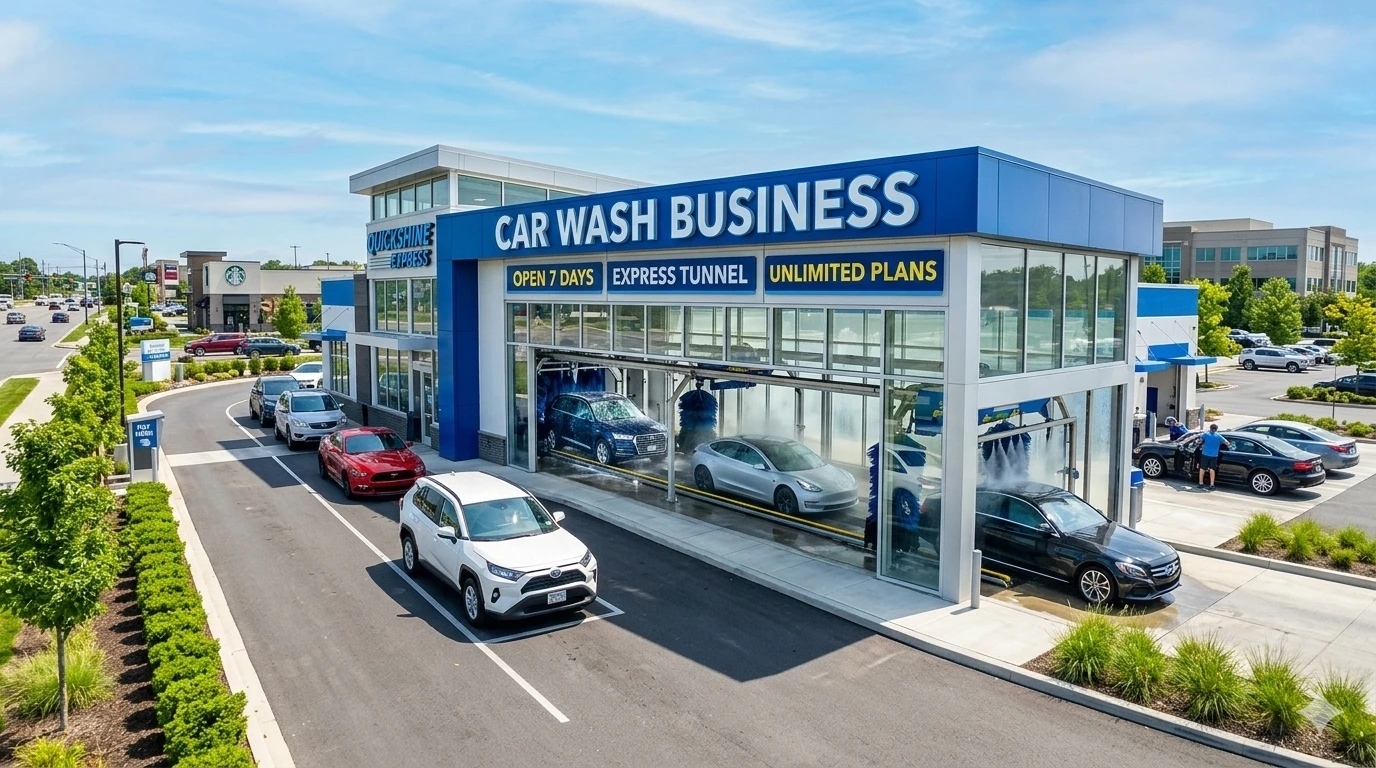
Here’s how I’d approach it from scratch, based on guidance from FindLaw, NEXT Insurance, NCS Wash, and Jobber (2024–2025).
Step 1: Pick Your Model
Everything downstream — location criteria, financing needs, permits, staffing — flows from this one decision. Be honest about your capital and commit before moving forward.
Step 2: Write a Real Business Plan
Not a formality. Every serious car wash business owner I’ve researched started with a plan that stress-tested their assumptions. Cover: market analysis, service menu, startup cost breakdown, 3-year financial projections, operations plan, and a subscription launch strategy. If your numbers only work under optimistic scenarios, better to know now than after you’ve signed a lease.
Step 3: Register and Get Your EIN
Form an LLC — it separates your personal assets from business liabilities (FindLaw, June 2025). Then get a free EIN at irs.gov. You’ll need it for your bank account, payroll, and taxes.
Step 4: Find Your Location
Location is the single biggest variable in whether your car wash business succeeds or fails. I’ve seen the same car wash business model thrive in one zip code and fail two miles away.
| Criteria | Target |
| Daily traffic on frontage road | 20,000–25,000+ vehicles |
| Lot size (tunnel) | 1.5–2 acres minimum |
| Lot size (in-bay) | Smaller footprint acceptable |
| Zoning | Confirm car wash use permitted |
| Ingress/egress | Easy entry and exit at road speed |
Get to know your local city planner early — they control permits and variances, and having a cooperative relationship before you need something makes everything faster (FindLaw, June 2025).
Step 5: Licenses, Permits, and Insurance
| Item | Notes |
| General business license | Required in virtually every state |
| Certificate of occupancy | Confirms zoning, fire, and building code compliance |
| Environmental permit | EPA Clean Water Act compliance for wastewater |
| Sign permit | Required to display signage legally |
| Sales tax permit | Needed if selling products alongside services |
| Car wash / polishing license | Only required in California and New York |
| General liability insurance | Non-negotiable |
| Property insurance | Non-negotiable |
| Workers’ compensation | Required in most states with employees |
| Garage liability / vehicle damage | Non-negotiable |
(Sources: NEXT Insurance 2025; FindLaw 2025; CarWashMavericks 2024; Jobber Oct 2025; KoronaPOS Apr 2025)
Step 6: Secure Financing
| Option | Best For |
| SBA 7(a) loan | Most car wash business startups — up to $5M, low down payment |
| SBA 504 loan | Buying land or heavy equipment (tunnel systems) |
| Conventional bank loan | Requires 20–30% equity + operating history |
| Seller financing | Acquisitions — seller carries part of purchase price |
| Equipment leasing | Preserves capital; finances conveyors and dryers |
| Investor partnership | Equity in exchange for capital |
Bring your business plan, personal financials, and a signed site agreement to every lender conversation.
Step 7: Buy and Install Equipment
For a tunnel, the core systems: conveyor, high-pressure wash arches, foam applicators, high-velocity dryers, POS with license plate recognition (LPR), water reclaim system, and vacuum stations.
For in-bay, you’re largely buying a single rollover unit (PDQ, Istobal, WashWorld) plus installation. Pay close attention to local service support — the nearest technician matters more than the brand name.
Step 8: Hire and Train Your Team
| Format | Typical Staff per Shift |
| Tunnel / Express | 2–4 (lane management, POS, maintenance) |
| Full-Service | Larger team for interior + exterior cleaning |
| Mobile | Owner-operated at launch |
The most important thing I’d train from day one: membership conversion. Every team member should know how to explain the subscription, handle objections, and close the upgrade at the register.
Step 9: Launch with a Membership-First Strategy
Don’t open the doors and hope subscriptions build organically. The smartest car wash business owners I’ve studied build their membership base before opening day:
- Pre-sell founding memberships at a discounted rate — recurring revenue before washing a single car
- Claim your Google Business Profile — most local car wash searches happen on Maps
- Do direct fleet outreach — one commercial account can generate $500–$2,000/month in guaranteed volume
- Run a grand opening promotion — free washes, local partnerships, email list signups
Step 10: Track Your KPIs Weekly
| KPI | Target / Benchmark |
| Cars washed per day | Track vs. capacity utilization |
| Membership conversion rate | Maximize % of single-wash customers who subscribe |
| Member churn rate | Under 8% annually |
| Average revenue per car | Tracks upsell effectiveness |
| Water cost per car | Efficiency + regulatory compliance |
| Equipment downtime hours | Measures maintenance effectiveness |
The operators growing fastest treat this like a subscription software business — they obsess over churn, LTV, and conversion rates, not just cars per day.
My Final Verdict
Based on all the research I’ve conducted — I do think the car wash business will be worth it in 2026. No other car wash business model offers low staffing, recurring revenue, and high throughput, like the tunnel format.
With some honest caveats: It’s worth it if you get the right model for your available capital. Don’t attempt to build a tunnel with a mobile budget. It’s worth it if you are ruthless with your location. A mediocre wash in an excellent position still beats a fantastic wash in an average position, every single time. It’s worth it if you start with subscriptions from day one.
Most operators without a membership model are disregarding most of their potential revenue. It’s worth it if you run it like a real business — real capitalization, maintenance budgets, and data-based decision making.
The car wash industry has sneakily become one of the most desirable small business investment categories in the entire U.S. and this is backed by data. The challenge is whether you are willing to execute the playbook correctly.
If you are still looking in other directions, take a look at this ranked list of business ideas 2026 for other suggestions across different budgets and risk appetite.


Top Clean Beauty Product Development Companies in the US (2026 Guide)
How to Name a Cosmetic Brand That Stands Out in 2026
Franchising a Beauty Salon: 7 Powerful Tips for Rapid Growth
How to Formulate Cosmetic Products for Beginners
Cosmetic Brand Business Plan: How to Build One That Works
How to Start a Cosmetic Business with Little to No Experience