

Most exhibitors consider the decision on the number of booth sizes critically. It has a direct effect on your presence, budget, and success in the trade show. This full-fledged guide discusses the standard trade show booth size, its major rules and regulations, and strategic planning. The knowledge of these factors will make you optimize the potential of your exhibition stand.
I. Trade Show Booth Sizes: Standard Dimensions and Configurations
Trade show planners have varied and standard display areas. The typical designs are useful to allow the exhibitors plan their space efficiently. Both types have certain pros & cons.
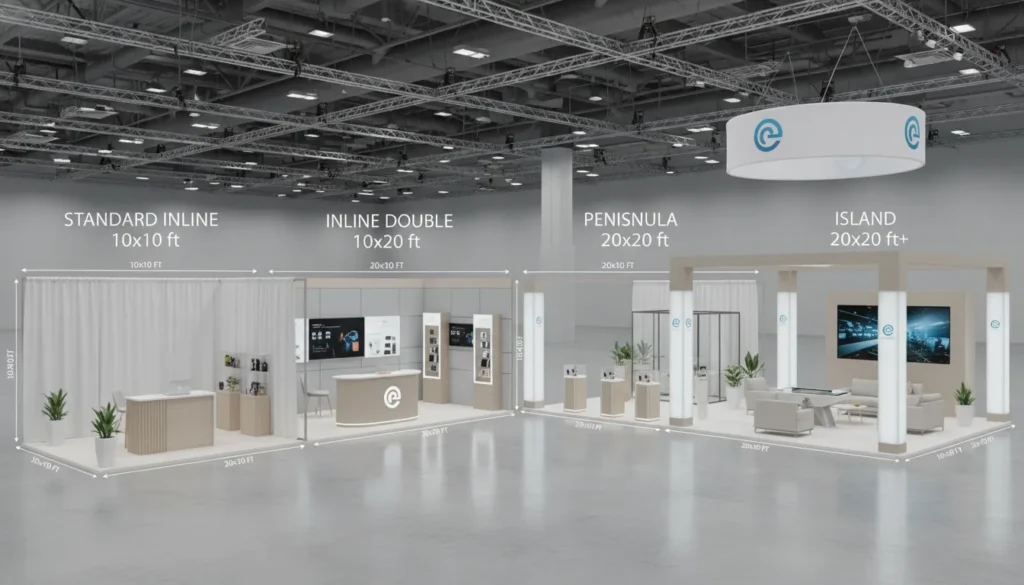
1. The Standard Inline (Linear) Booth: 10′ x 10′
This is the basic and widespread unit. It is 10 feet wide x 10 feet deep, hence 100 square feet. Neighbors on either side locate the booths in a straight line.
The 10×10 feet layout is perfect in first time exhibitors. It applies to companies that display small product demos or those that have one or two employees. One of its limitations is the 8-Foot Backwall rule. This rule usually allows the full 8-foot height only in the rear half of the booth, with a 4-foot restriction closer to the aisle, and limits the height of the display to 5 feet behind the depth of the booth.
2. The Inline Double: 10′ x 20′
An association of two line units forms an inline double booth. This leaves a 200 square feet area that is 10 feet deep and 20 feet wide. It gives it better frontage on the aisle.
With this increase in the size of the display area, you are able to have different areas in your exhibit. One side can have a counter of welcome, and the other can have a product showcase. It tends to abide by the linear height limit,s although it has a wider width. You cannot erect tall buildings in the center or front.
3. The Peninsula Booth: 20′ x 20′ (or larger)
There is more visibility to a peninsula booth. It is open to aisles at three sides. A booth of this kind usually supports the stand of another exhibitor. The size was reduced to a minimum of 400 square feet.
The booths on the peninsula are high in visibility and have two open corners. Most of the companies use them to upgrade themselves without spending more on the full island booth. One of the limitations is the appearance of the shared wall. You should properly complete it on behalf of the neighbor at the back.
4. The Island Booth: 20′ x 20′ (and up)
The island booth is the premium booth where companies can do major branding. It is open to aisles at each of the four sides. Usual measurements of island booths are 20 x 30 or 30 x 30. Organizers also offer custom configurations in larger sizes.
The island booth can be overhead rigged, including hanging signs. They are also fitted with tall towers to serve maximum brand impact. They, however, are subject to strict structural integrity rules. These booths may demand increased budgets for special flooring, electrical, and labor unions.
II. How Height Regulations Impact Booth Size
Knowing the event booth specifications is not limited to the footprint alone. The different rules and height are some direct factors that can determine the usage of the preferred size of your booth. People may overlook these and make expensive adjustments on the ground.
1. The “Cubic Content” vs. “Line-of-Sight” Rule
The 4-Foot Rule is important to standard linear booths. The front half (5 feet on aisle) should not have display materials more than 4 feet tall. This is to make sure that you do not obstruct the seating of your neighbor’s booth.
Breaking this rule may be very costly. Management of the show can make you take down some pieces of your display. You can always see the specifications of a certain event booth in the exhibitor manual.
2. Air Rights and Rigging
The freedom to use airspace is described as air rights. As a rule, inline booths do not have air rights. This implies that you will have no hanging of signs on the ceiling above your display area.
However, these are usually the case with island booths. They usually possess their limit height of 16 to 24 feet. This enables branding of high visibility. Overhead signs offer an excellent exposure of the whole show floor.
3. ADA Compliance and Floor Space
Access: This is one of the important details of event planning. All booth footprints should align with ADA. Staying clear of a walking path must be at least 36 inches wide to allow wheelchair-bound access.
Larger exhibition stand dimensions, like 20′ x 20′ booths, commonly have raised floors. These floors will have to have beveled sides. This helps to avoid cases of tripping and creates a safe atmosphere for all participants.
II. Booth Selection Strategies: Choosing the Perfect Booth Size
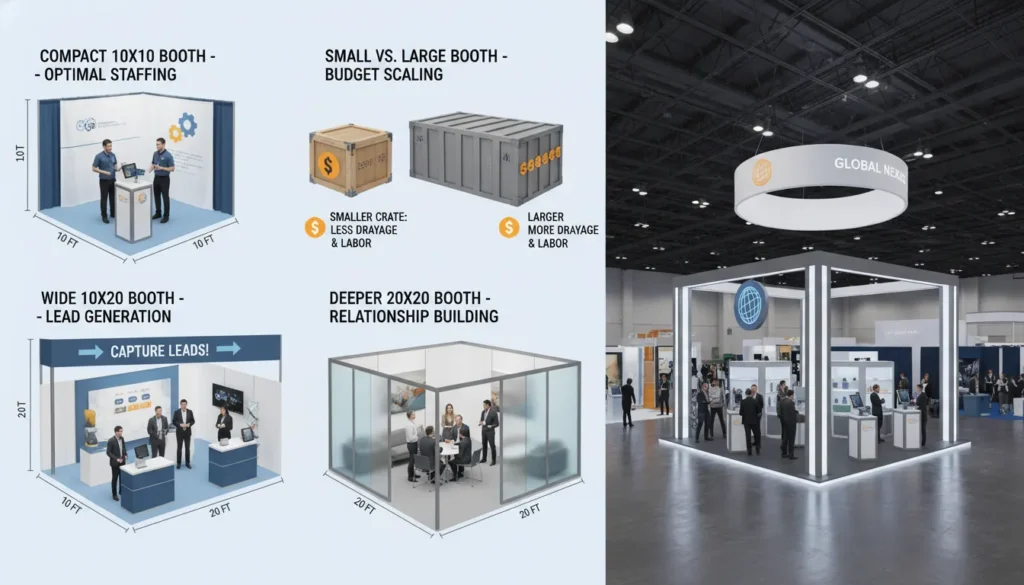
There is more than simply available space in choosing the ideal booth footprint. Strategic objectives and budget are important here. Take into account the sizes of sizes that match your aspirations.
1. The Staffing Density Formula
One golden rule of staffing is to estimate approximately 50 square feet of space per person in an open area. The formula will make sure that your booth is welcoming and workable. Cramping would discourage possible leads.
In this regard, a 10 ft. x 10 ft. (100 sq ft.) booth can comfortably accommodate two members of the staff. It is sometimes the addition of a third person that gives a human barrier. This can put off attendees who are planning to use your exhibit space requirements.
2. Budget Scaling Beyond Rent
The rent costs are not the only aspect. A 20′ 20′ normally costs 4 times what a 10ft 10ft is costing. It usually is eight times the overall cost. Different aspects contribute to this growth.
These vary as drayage (handling of materials), labor union charges, and rigging charges. Larger booths use crated freight, resulting in increased cost of material handling. Smaller sizes of the exhibition stands may mean that items can be skidded or heavy handed, thus saving these costs.
3. Mapping Size to Objectives
It is important to match your booth space with your event objectives. The different configurations serve different objectives. View what you want to accomplish during the trade show.
Lead Generation Focus: As far as width (e.g., 10×20) is concerned, prioritize. This optimizes the aisle front and counter. It enables interactions to be increased.
Relationship Building: Depth (e.g., 20′ x 20) is of priority. This establishes a semi-private meeting or relaxing lounge room. It encourages more serious discussions.
Brand Dominance: Lay emphasis on height (Island booth). Use overhead signage to be seen throughout the halls. This has a great impact on the visual factor.
IV. Layout Optimization for Every Booth Size
After you have chosen what your trade show booth measurements would be, maximize the layout. Good designs will guarantee that the visitors will interact with your display. It also fully uses the space.
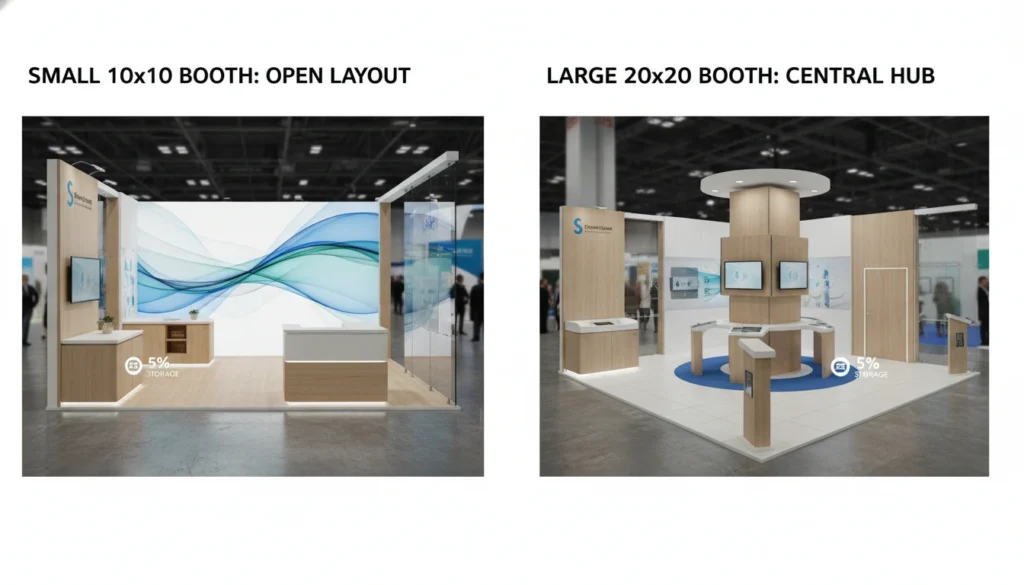
1. The Loop vs. The Wall
For small booths, do not have a table directly across the stand. This brings an effect of a barricade. Rather, apply an inverted L or U shape. This welcomes people into the depth of your space of 10 feet.
In bigger booths, form a center of gravity. This can be a demonstration booth or a high-profile reception place. This method assists in drawing traffic off the aisles to the centre of your stand. It encourages exploration.
2. Utility and Storage Integration
The calculation of the payable booth sizes should take dead space into consideration. This area is required to store electronic items, personal stuff, and cleaning products. You should fix this at approximately 5 percent of your total area.
Store in a podium counter in a 10′ x 10′ booth. In order to accommodate a 20ft x 20ft market stand, use a special closet. You may place this in a feature wall or central tower. Shelves conceal your booth so that it is tidy and professional.
V. Standard Booth Size Guide for Non-Trade Show Contexts (FAQs)
Although people associate it with trade shows, they practice the system of booth size in other places. The following are responses to the frequently asked questions,s such as non-trade show examples.
1. Common Questions on Trade Show Logistics
Can I combine two 10×10 booths myself?
Yes, but you have to buy them as a 10x 20 block with the organizer. You do this to make certain that organizers place no pipeline or drape partition between them.
What is a “Perimeter Booth”?
It is a linear booth that attaches to the exterior wall of the convention center. They tend to have high-back walls of up to 12 feet as opposed to the normal inline booths.
2. Grouping Non-Trade Show Booth Dimensions
What are the standard dimensions for restaurant dining booths?
- Standard Two-Top: 30″ wide x 24″ deep table.
- Standard Four-Top: 48-inch x 30-inch table.
- Sightline Depth: 16-18: This is comfortable.
How much space do different types of event photo booths require?
- Open Air: This one will need about 8′ x 8′ of floor area.
- Enclosed: Generally has a 5′ 4′ footprint.
- 360 Spinner: This needs a relatively safe area of approximately 10′ x 10′.
3. Comparing Booth Types by Investment
How do different booth types compare in terms of investment?
| Booth Type | Size | Setup | Structure | Investment Level | Key Advantages | Limitations |
| Portable | 10×10 | 1 person | Lightweight, portable system | Low | Easy transport, quick setup, low start-up cost | Limited space, basic design |
| Modular | 10×20 | 2 people | Engineered aluminum frames | Medium | Scalable, flexible exhibit space | Higher cost than portable |
| Custom (Island) | Custom | Union workers | Wood construction | High | Premium look, fully customized | Expensive, storage & reuse limitations |
VI. Conclusion: Balancing Booth Size with Budget and ROI
The choice of the best booth size is a strategic decision that extends beyond mere square footage. Although the 10′ x 10′ is the most common industry standard, the size that fits best is available, depending on your marketing objectives. It will also depend on how you can staff and use the space effectively.
Take into account the danger and reward. The size of a 10′ x 20′ can have a higher return on investment than a larger, poorly designed space. This is often the case in contrast to a large understaffed 20′ x 20′ island booth.
The individual event Exhibitor Manual will always list looking to price sheet. Fire codes and hall regulations are always more venue-specific than general guidelines. This precautionary action ensures a successful exhibition that complies.


Beauty Booth Conversion Strategy: 35% Sales Lift
Professional Beauty Event Guide 2025–2026: Global Calendar, Tips & ROI Playbook
Strategic Playbook for the Emerging Beauty Market: 2026–2030 Growth Guide
Professional Guide to Cosmetics Distributors in Moldova: Top Partners and Market Entry Strategies
Global Cosmetics Expo: Top 5 Key Insights For Shaping Beauty’s Future
Exhibition Booth for Beauty Brands: 10 Reasons You Shouldn’t Miss