

Living with melasma can be challenging. You diligently apply sunscreen, yet those stubborn dark patches persist or even reappear.
If you’re wondering why your efforts aren’t yielding the desired results, you’re not alone.
This guide, informed by dermatological expertise, will revolutionize how you think about sunscreen for melasma. We will explore advanced strategies that go beyond basic SPF ratings, giving you the knowledge to achieve clearer, more even-toned skin.
The Science of Melasma and Why Standard Sunscreens Often Fail
Melasma involves complex skin changes. It causes dark, discolored patches that often appear on the face.
Traditional sunscreens focus heavily on UVB protection. This is good for preventing sunburn, but sunscreen for melasma requires a much broader approach.
You need more than just sunburn protection.
Understanding the Protection Gap Between UVB and UVA1
Sunlight contains different types of ultraviolet (UV) rays. UVB rays are responsible for sunburn and contribute to skin cancer development.
UVA rays also play a big role. Many standard sunscreens block UVB and UVA2 well, but they often miss out on full UVA1 protection.
UVA1 rays penetrate deeply into the skin and reach the melanocytes — the cells that produce pigment. This deep penetration can trigger melasma.
The Impact of Long-Wave UVA1 on Deep Pigmentation
Long-wave UVA1 rays are particularly problematic for melasma sufferers. These rays stimulate melanocytes and push them to produce more pigment.
This leads to the dark patches you see. Even if your skin doesn’t burn, UVA1 can worsen melasma.
Your sunscreen for melasma must offer robust UVA1 protection — this is a critical factor.
Why Visible Light (HEV) is the Hidden Driver of Melasma
UV radiation isn’t the only culprit. Visible light has a significant impact as well.
High-Energy Visible (HEV) light is especially damaging. This includes blue light from screens and sunlight.
Most sunscreens do not offer protection against HEV light. As a result, your skin remains unprotected.
The Connection Between Blue Light and Melanocyte Hyperactivity
Studies show blue light activates melanocytes and causes them to overproduce melanin. This effect is similar to UV light.
For melasma, this is a major concern. You might be protecting against UV, but if you’re exposed to blue light, you’re still at risk.
This is why choosing the right sunscreen for melasma — one that blocks HEV light — is so vital.
Heat Sensitivity: Why Some Filters Can Worsen Pigment
Another commonly neglected factor is heat. Melasma is sensitive to heat, and increased skin temperature can trigger pigmentation.
Some sunscreen ingredients can absorb heat. This might inadvertently worsen your melasma.
You need to choose your products carefully and consider the thermal impact on your skin.
Chemical vs. Mineral Filters: The Thermal Energy Factor
Chemical sunscreens work by absorbing UV rays and converting that energy into heat. For melasma, this heat can be a problem.
Mineral sunscreens, like zinc oxide, work differently — they reflect UV rays and create a physical barrier. This process generates less heat on the skin.
This makes mineral formulas the preferred sunscreen for melasma. You should always prioritize mineral options.
The Medical-Grade Ingredient Checklist for Fading Melasma
Choosing an appropriate sunscreen is critical for melasma. It’s not just about SPF — it’s about specific ingredients.
These ingredients offer multi-faceted protection and help to treat existing pigmentation.
You need to consider more than just the label. Focus on what’s inside the bottle.
The Critical Necessity of Iron Oxides for Visible Light Protection
Iron oxides are a game changer for melasma. They are mineral pigments that give tinted sunscreens their color.
More importantly, they provide powerful protection against visible light, including blue light. Standard sunscreens lack this protection.
Always choose a tinted sunscreen for melasma that contains iron oxides.
How Pigment Particles Create a Physical Shield Against Blue Light
Iron oxide particles work by reflecting and scattering visible light. They sit on the skin to create a physical barrier.
This shield prevents blue light from reaching melanocytes, stopping the pigmentation process.
Look for formulations that clearly state they contain iron oxides — this ensures comprehensive protection.
Zinc Oxide and Titanium Dioxide: The “Gold Standard” Physical Blockers
These two ingredients are absolutely necessary. Zinc oxide and titanium dioxide work as mineral filters on the skin’s surface.
They reflect both UVA and UVB rays and offer broad-spectrum protection. They are gentler on sensitive skin and less likely to cause heat buildup.
This makes them ideal ingredients in any sunscreen for melasma.
Why Broad-Spectrum Physical Barriers Outperform Chemical Alternatives
Mineral sunscreens provide immediate protection and do not need to be absorbed into the skin. They are known to be gentle and well tolerated.
Chemical filters can sometimes cause irritation, which can worsen melasma. Mineral filters offer a superior barrier and reduce the risk of further pigmentation.
Always opt for physical blockers — they give you the best defense.
Synergistic Actives: Sunscreens That Treat While They Protect
The best sunscreen for melasma does more than just block rays. It also contains active ingredients that help to fade existing pigmentation.
They work by targeting the pigmentation process directly. This two-in-one approach is highly effective.
You get both protection and treatment in one product.
The Benefits of Niacinamide, Vitamin C, and Tranexamic Acid in SPF
Niacinamide (Vitamin B3): This ingredient reduces inflammation and interferes with pigment transfer. It helps to prevent melanin from reaching the skin’s surface.
Vitamin C (Ascorbic Acid): A powerful antioxidant that brightens the skin and inhibits melanin production. Vitamin C also boosts sunscreen efficacy.
Tranexamic Acid: This acid specifically targets melasma, reduces UV-induced pigmentation, and helps to calm overactive melanocytes. Look for a sunscreen for melasma that includes these actives for enhanced results.
Top-Rated Sunscreens Categorized by Skin Type and Need
Finding the perfect sunscreen for melasma can feel overwhelming. There are so many options.
Your skin type and lifestyle determine the right choice. Here are some top recommendations that excel in melasma protection and incorporate the key ingredients we discussed.
The Highest-Performing Formulas for Pigment Stabilization
These sunscreens are chosen for their advanced formulations. They offer superior protection and help to stabilize existing melasma.
They are designed to meet your individual needs. Consider these choices to begin your journey to clearer skin.
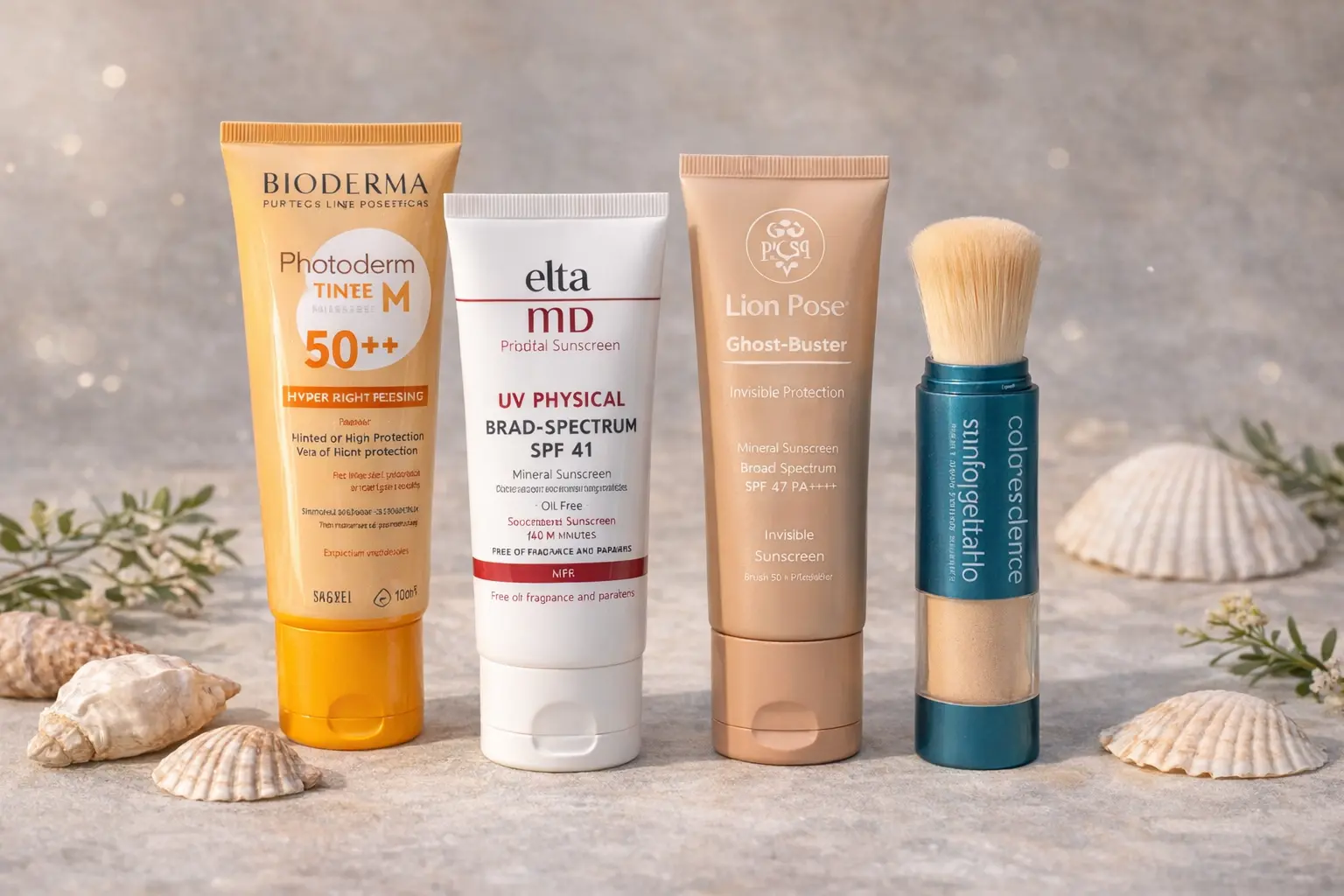
Best Overall Protection: Bioderma Photoderm M (High Iron Oxide)
Many dermatologists consider this a top choice. It boasts SPF 50+ and provides very high UVA protection.
Crucially, it contains a significant concentration of iron oxides for excellent visible light protection. The product is tailored for skin prone to hyperpigmentation.
This is a strong contender as a daily sunscreen for melasma.
Best for Post-Procedure and Sensitive Skin: EltaMD UV Physical
EltaMD UV Physical is a mineral-based formula. It uses zinc oxide and titanium dioxide, and is tinted with iron oxides.
This provides broad-spectrum and visible light protection. It is also gentle, fragrance-free, and paraben-free.
This makes it ideal as a sunscreen for melasma on sensitive or post-procedure skin.
Best for Melasma on Deeper Skin Tones: Lion Pose Ghost-Buster
On deeper skin tones, many mineral sunscreens can appear chalky or leave a white cast. Lion Pose Ghost-Buster addresses this issue.
It contains zinc oxide and titanium dioxide with a seamlessly blending tint. It uses iron oxides for HEV light protection and leaves no ghosting.
It’s perfect as an invisible sunscreen for melasma on deeper complexions.
Best for On-the-Go Reapplication: Colorescience Sunforgettable Powder
Reapplication is vital but can be tricky, especially over makeup. Colorescience Sunforgettable is a powdered mineral sunscreen.
It contains zinc oxide, titanium dioxide, and iron oxides. This brush-on powder offers easy reapplication throughout the day without disturbing your makeup.
It’s an excellent tool for consistent sunscreen for melasma protection all day long.
The Professional Protocol: How to Layer and Reapply for Maximum Efficacy
Having the right sunscreen for melasma is only half the battle. Proper application matters as much as the product itself.
A professional protocol ensures maximum protection. Consistency and thoroughness are essential.
These techniques will make a real difference in your results.
Mastering the Application Technique for Full Coverage
Adequate sunscreen application is crucial. Many people use too little, which reduces the stated SPF.
You need to ensure every bit of exposed skin is covered. Don’t forget your hairline, ears, and neck — we often miss these areas.
Consistent coverage is your best defense.
The Two-Finger Rule: Ensuring Precise SPF Dosage
A simple way to measure is the “two-finger rule.” Squeeze a line of sunscreen down your index finger, then repeat on your middle finger.
This amount is generally enough for your face and neck. Apply this much every time to ensure you’re getting adequate protection from your sunscreen for melasma.
Don’t skimp on your sunscreen.
Strategic Layering for Antioxidant Synergy
Layering products can boost your defense and create a stronger protective shield. Combining certain ingredients enhances the benefits of your sunscreen.
This strategy provides a multi-pronged attack. It protects your skin from various stressors simultaneously.
Why Vitamin C Underneath Sunscreen Doubles Your Defense
Applying a Vitamin C serum before your sunscreen for melasma is a powerful strategy. Vitamin C is a potent antioxidant that neutralizes free radicals generated by UV and visible light.
It also helps to repair skin damage. When used together, Vitamin C and sunscreen offer enhanced, synergistic protection.
This combination truly doubles your defense.
The Reapplication Standard for All-Day Pigment Suppression
Sunscreen does not last all day. Its effectiveness wears off due to sweat, water, and rubbing.
Consistent reapplication is vital for maintaining your protection and preventing melasma from flaring up.
You need to make it a habit.
Tactics for Reapplying Over Makeup Without Disturbing Coverage
Reapplying sunscreen over makeup is possible. Powder sunscreens like Colorescience Sunforgettable are excellent for this.
Tinted mineral mists or sprays can also work — gently pat them onto your skin using a beauty blender.
Aim to reapply your sunscreen for melasma every two hours, and more often if sweating or swimming.
Expert Q&A: Addressing the Nuances of Pigment Management
Managing melasma brings many questions. It’s a condition with unique challenges.
Getting clear answers helps you make informed decisions. Here, we tackle some common queries.
Is it possible to clear melasma using only sunscreen?
No, it is generally not possible to clear melasma using only sunscreen. While sunscreen for melasma is the single most crucial step in preventing worsening and helping to fade pigmentation, it is usually not sufficient on its own.
Melasma often requires a multi-pronged approach, including topical lightening agents such as hydroquinone or retinoids. Chemical peels or laser treatments may also be necessary.
Sunscreen prevents new pigmentation and stops existing spots from getting darker — but active ingredients are often essential for fading.
What is the specific medical definition of “Tinted” SPF?
In a medical context, “tinted” SPF refers to a sunscreen formulation that contains mineral pigments, most notably iron oxides. These pigments provide cosmetic coverage and, more importantly, protection against visible light including blue light.
This visible light protection is crucial for melasma management. It is a functional benefit, not just a cosmetic one.
The tint helps your sunscreen for melasma block a broader spectrum of light beyond just UV rays.
Which ingredients to group for faster fading
For faster melasma fading, a synergistic approach is best. A common and effective combination includes:
Tyrosinase Inhibitors: Such as hydroquinone, arbutin, kojic acid, or azelaic acid. These block the enzyme responsible for melanin production.
Exfoliants/Cell Turnovers: Such as retinoids (tretinoin, retinol). These increase cell turnover, helping to shed pigmented skin cells.
Anti-inflammatories/Antioxidants: Such as niacinamide, vitamin C, or tranexamic acid. These reduce inflammation and neutralize free radicals that can trigger pigmentation.
Combining these ingredients under a dermatologist’s guidance yields the best results. Always use your sunscreen for melasma daily to protect these treatments.
How does medical-grade tinted SPF compare to cosmetic foundation?
Medical-grade tinted SPF offers significant advantages over cosmetic foundation for melasma. It is formulated with robust UV and visible light filters — zinc oxide, titanium dioxide, and iron oxides — that deliver active protection.
Cosmetic foundations, even those with SPF, often lack sufficient protective filters. Their primary purpose is color correction, not sun protection.
For melasma, always prioritize medical-grade sunscreen for melasma. You can then use a lightweight foundation over it if needed.
Long-Term Maintenance: Preventing Rebound Pigment and Closing the Protection Loop
Managing melasma is a marathon, not a sprint. Even after successful treatment, vigilance is key.
Melasma has a high tendency to recur, especially with inconsistent protection. Establishing robust habits is essential.
The Threat of Rebound Melasma from Inconsistent Protection
Melasma is very sensitive to triggers. Even brief sun exposure can undo months of progress — this is known as “rebound melasma.”
The dark spots can return even darker than before when you relax your protection routine.
Consistent use of sunscreen for melasma is non-negotiable. It is your best defense against recurrence.
How Brief Exposure Triggers Months of Treatment Reversal
A short walk to your mailbox without sunscreen can be enough. A few minutes in the car by a window can cause harm.
These brief exposures accumulate, stimulate melanocytes, and can reverse weeks or months of diligent treatment.
Always wear your sunscreen for melasma — even for short periods outside, even on cloudy days.
Establishing an Indoor Standard for Device and Window Exposure
Protection isn’t just for outdoors. Windows allow UVA and visible light to enter, and device screens emit blue light.
Both can worsen melasma. This means your sunscreen routine must extend indoors.
Don’t let your guard down when inside your home or office.
Protecting Against HEV Light from Screens and Indoor Lighting
If you work near a window or spend hours on screens, your tinted mineral sunscreen for melasma with iron oxides is vital.
Apply it every morning and treat it like a daily moisturizer. This ensures continuous defense.
This indoor standard is a crucial part of closing the protection loop.
Final Summary: Consolidating Benefits for Permanent Melasma Remission
Effectively managing melasma requires a multifaceted strategy. It goes far beyond a simple SPF number.
You now understand the critical role of comprehensive sunscreen for melasma — blocking not just UVB, but also UVA1 and visible light (HEV) with iron oxides.
Choosing mineral-based, tinted formulas is paramount. Remember to incorporate synergistic actives like niacinamide and Vitamin C to treat your skin while protecting it.
Mastering application techniques, such as the two-finger rule, ensures adequate coverage. Consistent reapplication, even over makeup, is non-negotiable.
Commitment to daily, year-round protection — including indoor exposure — is key. By adopting these dermatologist-led principles, you can achieve clearer, more even-toned skin.
Always choose the right sunscreen for melasma. It truly is your best friend in this journey.


Safe Suntan Lotion Pregnancy: Top Picks Recommended by Doctors
Pregnancy Safe Makeup: A Comprehensive Guide to Non-Toxic Beauty
Best Sunscreen for Laser Hair Removal 2026 (Dermatologist Picks)
Sun Exposure After Laser Hair Removal: Safety Guide & Recovery Timeline
What Is a Skin Tonic Toner? How to Use It Effectively?
5 Picks for the Best Face Wash for Rosacea: Soft, Simple Care