
Embarking on the journey to launch your own cosmetic brand is exciting, but success requires more than just great products.
It demands a clear roadmap, and that’s precisely where a comprehensive cosmetic brand business plan comes in.
This vital document serves as your strategic blueprint, guiding every decision from product development to market entry and beyond. We’re here to help you craft a plan that truly works.
1. What a Cosmetic Brand Business Plan Is (and Why It Matters)
A cosmetic brand business plan is a detailed document outlining your brand’s goals, strategies, and operational procedures.
It covers everything from your vision and target audience to your marketing tactics and financial projections.
Think of it as a living document that evolves with your business.
The main goals of such a plan are multifaceted. To begin with, it helps attract funding from investors or banks by clearly presenting your vision and expected returns.
Secondly, it aligns your team, ensuring everyone is working towards common objectives.
Finally, it acts as a steadfast guide for the launch and ongoing growth of your brand.
You might wonder why a generic “beauty business plan” isn’t enough. The truth is, a branded cosmetic line faces unique challenges and opportunities.
You need to address specific product formulation, regulatory compliance, branding nuances, and a highly competitive beauty industry.
A specialized cosmetic brand business plan reflects this unique landscape far more effectively.
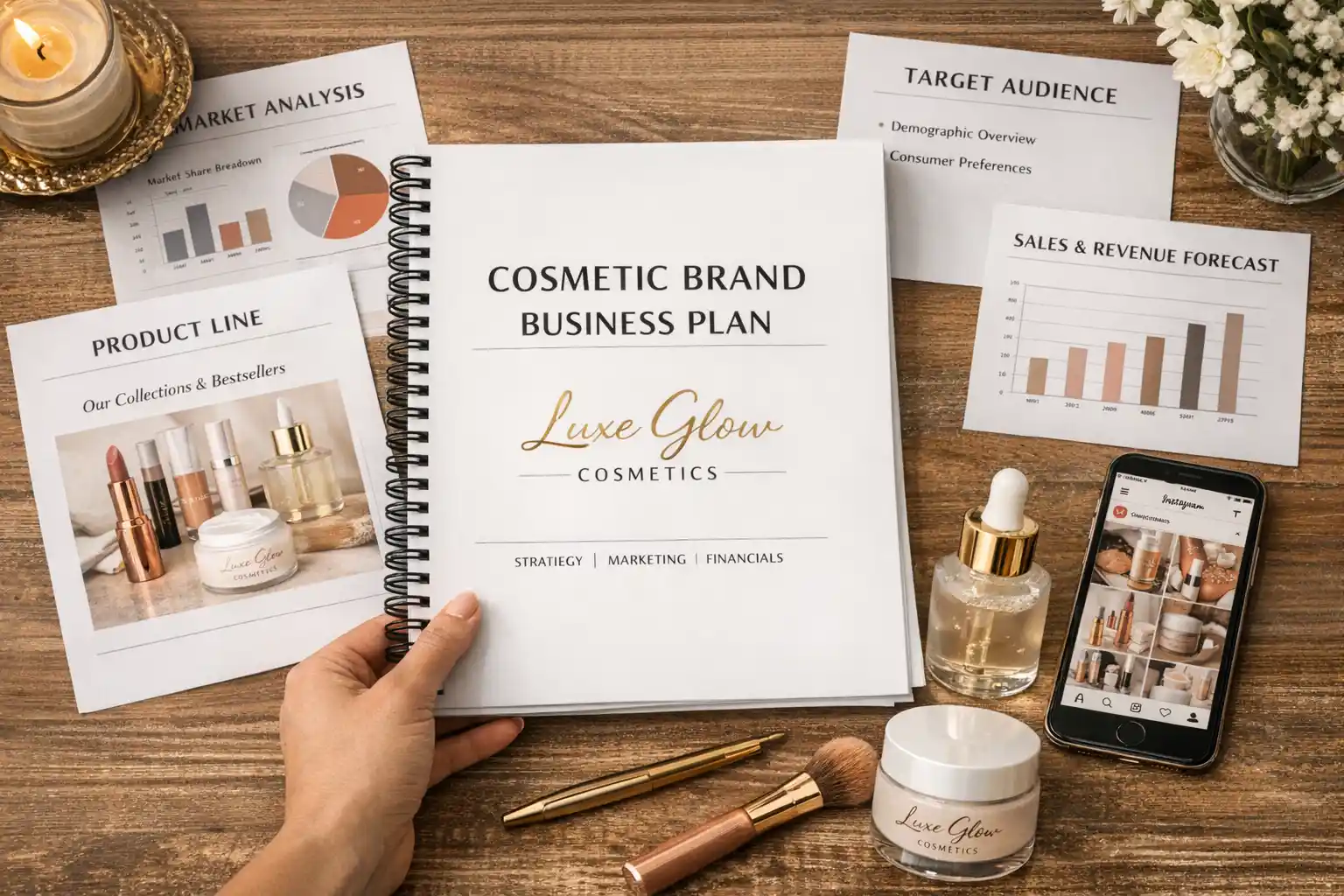
2. Core Structure of Your Cosmetic Brand Business Plan
Every strong cosmetic brand business plan includes essential sections that provide a holistic view of your venture.
We typically advise including elements like an executive summary, company description, market analysis, product details, marketing strategy, operations plan, management team, and financial projections.
These 8 sections form the backbone of your strategy.
The length of your plan depends heavily on your audience. For a quick internal reference or pitch, 10–15 pages might suffice.
However, for investors or loan applications, a more detailed 20–30 page document offers the necessary depth.
Always tailor your plan to who will be reading it.
You can adapt the same outline for various audiences effectively. For investors, emphasize market opportunity and financial return.
For banks, focus on revenue models and risk mitigation. For internal use, prioritize operational details and team responsibilities.
Flexibility is key to maximizing the plan’s utility.
3. Brand, Market, and Competitive Positioning
Start with a clear company overview. It outlines your legal setup, ownership details, and where your business currently stands, from concept to early sales.
Transparency here builds trust and clarity.
Your brand identity is the heart of your cosmetic venture. Define your mission, core values, and positioning in the market, all tailored to modern cosmetic consumers.
What unique promise does your brand make? What ethos drives your product development and customer engagement?
Identifying your target audience is paramount. You need to define your ideal cosmetic customer, understanding their demographics, psychographics, and buying habits.
This insight informs everything from product formulation to marketing strategy. Knowing who you’re speaking to makes your message resonate.
A thorough market analysis is critical for understanding the broader beauty industry. Look at the size of the market and key cosmetic trends supporting your brand, like clean beauty, K-beauty, and the rise of DTC sales.
This shows you’re tapping into viable trends.
Finally, conduct a robust competitor analysis. Identify both direct and indirect competitors in your space.
Crucially, outline how you will make your brand stand out. What makes you stand out? This could be your unique formulations, sustainable packaging, or innovative distribution network.

4. Products, Formulation, and Compliance
Detail your specific product line, including categories and SKUs. Will you focus on skincare, makeup, haircare, or offer a mix?
Clearly outlining your initial offerings and potential product line expansion helps define your market presence and future growth trajectory.
Your formulation strategy is a core component of your brand story. Are your products clean, natural, cosmeceutical, vegan, or halal?
This choice significantly shapes your brand narrative, informs your initial investment, and impacts your cost structure. Be clear about your scientific approach.
Packaging design and sustainability are no longer optional but essential. Consider materials, refillability options, and shelf-life considerations.
Sustainable packaging can be a significant differentiator and appeals strongly to an environmentally conscious target audience.
Navigating regulations and compliance is a non-negotiable aspect of the beauty industry. Familiarize yourself with key frameworks such as EU-CPNP, US FDA guidance, or ASEAN-HMAC.
Non-compliance can lead to severe penalties and reputational damage.
Proper labeling, INCI lists (International Nomenclature of Cosmetic Ingredients), claims substantiation, and required safety testing are all critical.
Ensure every claim you make about your product is backed by scientific evidence. This builds consumer trust and avoids legal issues.
Working with experienced labs, reputable manufacturers, and cosmetic regulatory consultants is highly recommended.
By handling quality, safety, and regulatory requirements, these partnerships free you to concentrate on developing your brand.
5. Marketing, Sales Channels, and Operations
Your branding and visual identity must clearly support your market positioning. Develop mood boards, create a compelling logo, and define a consistent tone of voice.
These elements are crucial for customer engagement and forming an instant connection with your target audience.
Next, outline your sales channel strategy. Are you planning to sell through your own ecommerce site, third-party marketplaces, physical stores, or a hybrid model?
Each channel has its own profit margin implications and operational demands.
Develop a step-by-step digital marketing plan. Your plan should outline how you use SEO, social media, influencers/KOLs, and email marketing to attract and connect with customers.
A robust plan drives sales and brand awareness.
For operations and supply chain management, consider your manufacturing options. Will you produce in-house, partner with a Contract Manufacturing Organization (CMO), or opt for white-label products?
Detail your sourcing, warehousing, and fulfillment processes to ensure smooth delivery.
Effective quality control and inventory management are critical to avoiding common pitfalls. Implement strategies to prevent overstock situations, stockouts that disappoint customers, and formula failures.
This directly impacts your business scalability and profit margin.
For more tips on business development, see How to Build a Cosmetic Brand With a Low Budget
6. Financials, Funding, and Action Next Steps
Clearly detail your startup costs. This encompasses everything from formulation and testing to packaging design, branding, website development, and your crucial first inventory order.
Understanding these initial investment needs is foundational to securing funding.
Define your revenue model. Will sales come from direct sales, wholesale accounts, subscription services, or product bundles?
A clear revenue model helps project future earnings and demonstrates how your business will generate consistent income.
Provide 3- to 5-year financial projections. This includes detailed forecasts for sales, Cost of Goods Sold (COGS), gross margins, marketing spend, and net profit.
Realistic projections are essential for convincing investors and guiding your business decisions.
Conduct a break-even analysis to determine when your brand will start turning a profit. This data should support your funding ask by clearly showing how the investment leads to profitability and expansion.
This is a key metric for any solid cosmetic brand business plan.
Remember, your cosmetic brand business plan is a living document. Commit to updating it regularly with real-world data and key performance indicators (KPIs).
This iterative approach allows you to adapt to market changes and refine your strategies for sustained success.
Avoid common pitfalls such as over-optimistic projections, under-estimated regulatory costs, and ignoring potential supply chain risks.
A realistic assessment of challenges is just as important as highlighting opportunities. Thorough competitor analysis helps mitigate these risks.
To truly bring your vision to life, utilize available templates and tools. These resources will help you transform this outline into a professional plan for starting your cosmetic brand.
Don’t let your plan sit on a shelf; use it as your strategic compass.
FAQ Section
Q1: How important is regulatory compliance for a new cosmetic brand?
Regulatory compliance is absolutely critical. Failing to adhere to standards set by bodies like the FDA in the US or CPNP in the EU can result in product recalls, hefty fines, and severe reputational damage.
It should be a top priority from day one of product development.
Q2: What’s the most challenging part of developing a cosmetic brand business plan?
Many entrepreneurs find financial planning and accurate projections the most challenging. Estimating initial investment, predicting sales, and forecasting profit margins require careful market analysis and a realistic understanding of the beauty industry dynamics.
However, thorough research and expert consultation can make this manageable.
Q3: How often should I review and update my business plan?
Your cosmetic brand business plan should be a dynamic document, reviewed and updated at least annually, or whenever significant changes occur.
This includes product line expansion, shifts in market trends, new competitor analysis insights, or adjustments to your marketing strategy.
Regular updates ensure it remains relevant and useful.
A well-crafted business plan is essential to turning your cosmetic brand into a long-term, successful venture.
When you clearly plan brand identity, market trends, finances, and regulations, you set your business up for steady growth.
This strategic document empowers you to navigate the complexities of the beauty industry, attract crucial investment, and confidently launch your dream cosmetic brand.
Start building your cosmetic brand business plan today and turn your vision into a thriving reality.


Financial Planning for Salon Growth: 6 Proven Strategies for Big Wins
7 Powerful Salon Expansion Strategies & Key Performance Metrics
How to Grow a Beauty Salon: 7 Powerful Ways to Scale Smart
How to Build a Cosmetic Brand With a Low Budget
Franchising a Beauty Salon: 7 Powerful Tips for Rapid Growth
Cosmetic Labeling Requirements Explained (US, EU & Global Standards)