
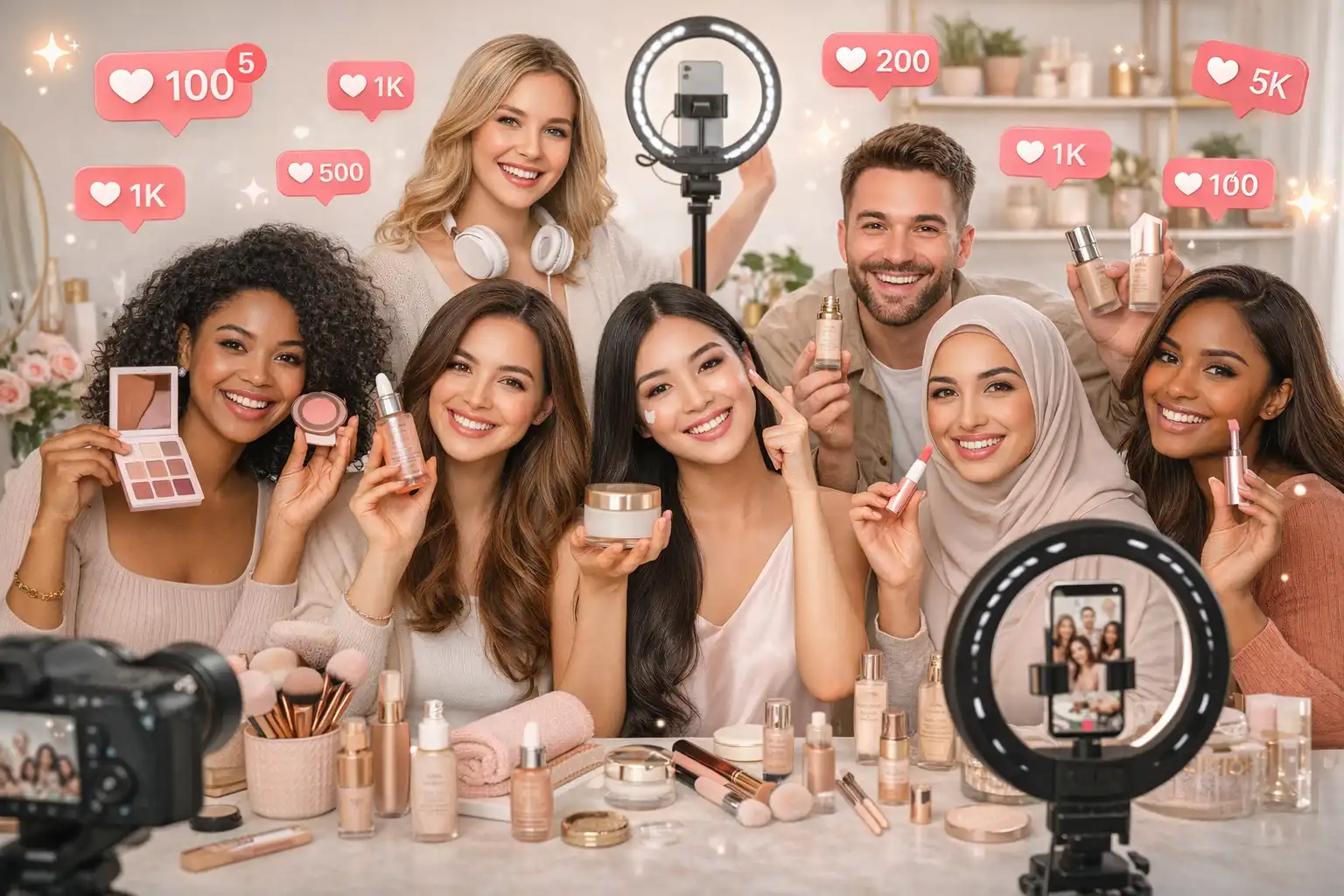
You want to be part of the changing beauty world where the trends roll like lipstick colors! Influencer marketing for beauty brands is mandatory to brand beauty fillers, looking at cutting the noise and adding value. It is a channel through which we get in touch with the target audience, make them trust and present the products in a natural, captivating manner. In the ultimate manual, we’ll discuss the ways that you can use the influence of digital to make your brand rise.
Introduction
Why influencer marketing matters for beauty brands
Customers in the cosmetics sector usually want references from someone they have trusted before they can make a purchase. Influencer marketing for beauty brands is those voices of trust, which provide truth in product marketing and aesthetic narrations that will thrive in followers. This strategy causes a high consumer involvement and more properly gathers brand loyalty compared to conventional advertising.
Current trends in 2026 for beauty influencer campaigns
Moving on to the future, influencer marketing for beauty brands is experiencing emerging priorities of authenticity and enduring relationships. Micro-influencers and nano-influencers become popular due to high engagement levels and a target audience within a niche. Social media campaigns are still dominated by video content, especially short-form reels and TikToks, which cause brand awareness to grow rapidly and provide a chance to get viral via marketing efforts. Influencer offered product development and co-created content are also increasing.
What this guide will cover
These tips will take you on a journey to complete eight essential steps, such as setting campaign objectives and evaluating ROI and strategy scaling. We will also point out pitfalls to stay out of and provide the answers to the most frequently asked questions, having prepared you with the knowledge to make the successful collaboration of beauty influencers.
Step 1 – Define The Goals Of Your Campaign
When we are going to approach any influencer, we should clearly understand what we want to accomplish. Having clear goals will make all decisions, including selecting an influencer or the type of content to use, have a specific purpose.
Awareness vs. sales vs. product launch
Are we trying to achieve more brand awareness, generate certain product promotion, or create higher conversion rates for the already existing lines? Every goal of influencer marketing for beauty brands will need a variation in the selection of influencers, the type of content, and the campaigning processes. Transparency here will avoid wastage of budget and misdirected associations.
Setting measurable KPIs
It is essential to set quantifiable Key Performance Indicators (KPIs). That might consist of such measures as engagement rates, traffic, sales, or the number of followers. There will be no KPIs to measure the success of a campaign and the parts that need improvement.
Choosing campaign duration and format
Think about the perfect campaign length and type, a one-time burst of a seasonal product, and the long-term nature of a hero product. Based on product launch, short-term initiatives are effective, but longer initiatives are effective in developing brand loyalty and ambassador relationships in the long term.
Step 2 – Identify the Right Influencers
The most important thing to do is to find a perfect match. The right influencer will increase your brand message, whilst the wrong one will consume your budget.
Types of influencers: nano, micro, macro, celebrity
We divide the types of influencers: nano (1K-10K followers), micro (10K-100K), macro (100K-1M), and celebrity (1M+). Each type has its own benefits. Micro-influencers may have better engagement and trust in their niche, whereas celebrity influencers have a massive reach in the case of general brand awareness.
How to evaluate engagement, audience fit, and authenticity
Not only consider the number of followers of the partners, but also their audience, their interaction rates (likes, comments, shares), and their authenticity. An influencer who has 20,000 very engaged followers in the target demographic will regularly perform significantly greater than one who has disengaged followers of 500,000.
Tools to find beauty influencers
Services such as HypeAuditor, Upfluence, or even the in-built analytics of Instagram can assist us in determining those beauty influencers whose following will fit our target demographic and brand beliefs perfectly. The platforms offer information about the demographics of the followers, levels of engagement, and previous brand partnerships.
Step 3 – Budgeting & Negotiation
The calculation of influencer charges may be a complicated process that depends strongly on the number of followers, engagements, content nature, and exclusivity. The most significant basis of successful influencer marketing for beauty brands is smart budgeting.
Determining influencer fees
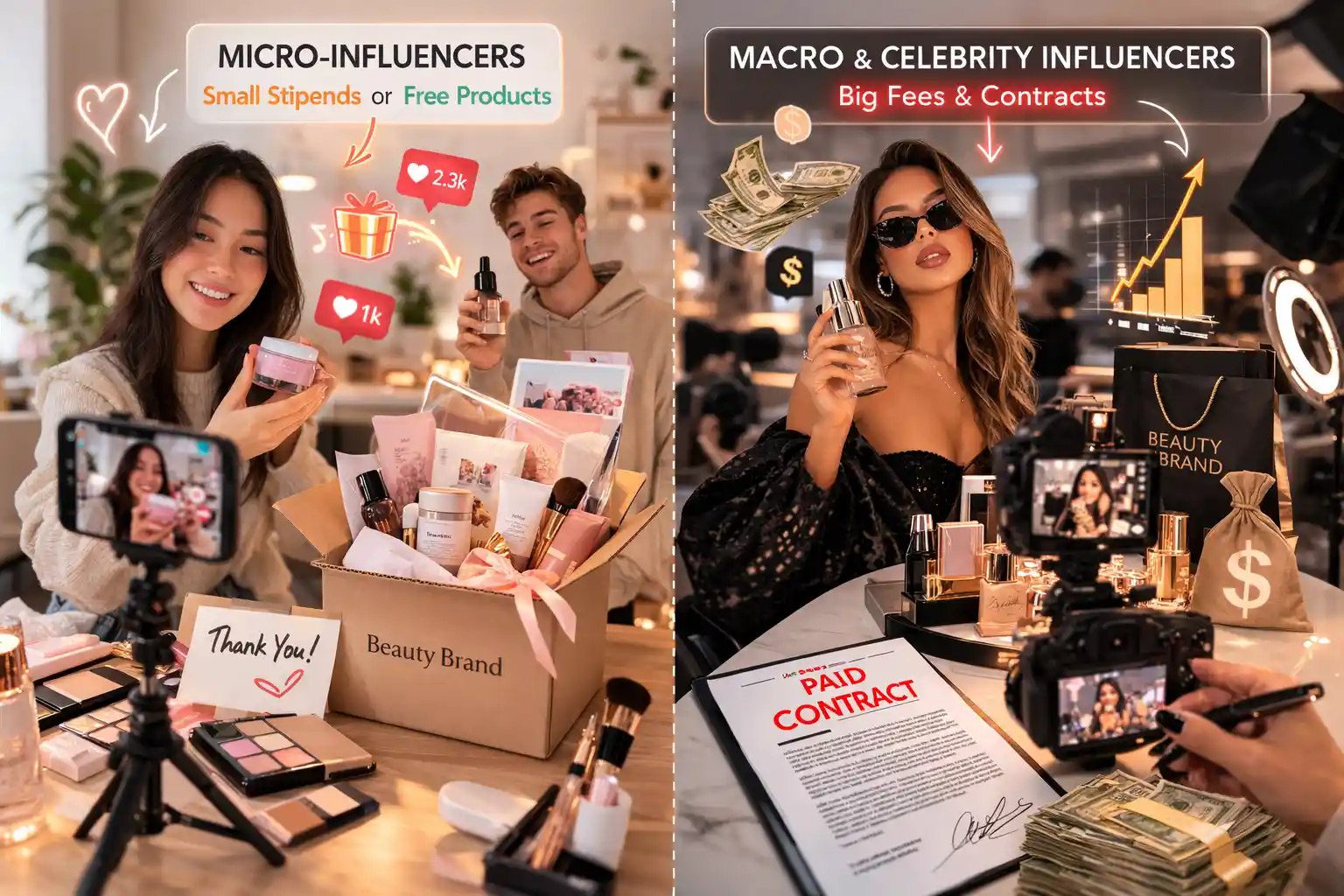
Micro and bigger stipends or even free products may be offered to micro-influencers and big fees to macro or celebrity influencers. Consider content usage rights, exclusivity term, and the number of deliverables in determining your budget based on the research industry standards.
Negotiating collaborations and perks
We are to be ready to negotiate partnerships, providing not only financial rewards but also such benefits as first of the new products or invitations to events, or an opportunity to develop a partnership in the long run. A significant number of influencers appreciate non-monetary incentives that comply with their content objectives and personal brand concept.
Micro-influencer vs. celebrity ROI comparison
An attentive ROI analysis of the micro influencer campaigns and the celebrity endorsement will help make investment choices. Micro-influencers generally have higher conversion rates with the population, whereas celebrities are suitable for mass awareness and brand positioning campaigns.
Step 4 – Outreach & Relationship Building
When reaching influencers, one should be professional and personal to achieve an impact in a large inbox.
How to contact influencers professionally
Individualised emails that display the reasons their particular digital influence relates to our brand are much more efficient than generalised emails. Cite their new material, describe the two-way benefit of the partnership, and make the preliminary communication brief and defer to their time.
Sending PR kits & product samples
The influencers often get a complimentary taste of our products by having them sent straight to them in a well-selected PR package and a sample made up of our products. Even the PR kit itself, with its aesthetic of your brand, will be a shareable item, creating the sort of organic buzz that will take place even before your actual campaign.
Maintaining long-term partnerships
It is aimed at developing long-term collaborations, influencers should become members of our team as genuine extensions of the brand ambassadors, promoting respect towards one another and regular cooperations. Sponsored content created in long-term relationships is more authentic and generates better audience trust in comparison to one-off sponsored content.
Step 5 – Create Campaign Content
The most effective influencer marketing for beauty brands is a symbiosis of the messages of our brand and the voice of an influencer.
Aligning brand and influencer voice
We work in close cooperation so that the content creation is in line with our general social media campaigns and yet comes naturally to their audience. The audience is able to verify inauthenticity within a short time, and the force or out-of-character content created by the influencer will do nothing, no matter how well it is executed.
Content formats: posts, reels, TikTok, YouTube
One can find all types of content, starting with Instagram posts and Reels and moving on to engaging TikToks and detailed YouTube reviews. Select forms depending on the areas of greatest activity of your target audience and the nature of the content that preannounces your product category.
Co-creating content vs. giving creative freedom
It is up to the desired result of our campaign and the already established style of the influencer, as well as the need for co-creation and more detailed guidelines that determine how much freedom of choice he/she should receive. As a rule, the more creative leeway influencers have, the more natural the outcomes, and the more precise the briefs are when launching a product that necessitates particular messages.
Step 6 – Launch & Promote Your Campaign
When content is prepared, strategic execution gets maximum impression and presence.
Scheduling posts for maximum impact
It is essential to schedule the posts in a way that they can have a maximum impact, which is commonly coordinated with the times when the audience is most active. Post several times every week (coordinate) so that you build some momentum, and think about timing, in relation to any activities (like events or holidays) or around trending beauty topics.
Using hashtags, mentions, and tags effectively
It is done by making sure that influencers employ certain hashtags, brand handle mentions, and tags on products to expand their reach and make sure they are trackable at all times. Stable hashtag approach also assists in collecting campaign-related information and makes it easier to track the results.
Leveraging multi-channel promotion
In addition to the means of the influencer, the promotion should take advantage of cross-channel promotion in our owned media. Resharing influencer work on your Instagram, TikTok, email newsletters, and site is a way of integrating the campaign into your overall marketing system.
Step 7 – Measure Results & ROI
The success is something that needs measuring. Without this proper monitoring, we are not able to know what is working. In addition to this, we are not able to justify future investment in influencer marketing for beauty brands.
Tracking clicks, engagement, and conversions
We are monitoring different data, including clicks and engagement rates, as well as the real conversion and sales. Find a baseline of where to start before the campaign starts so that you can compare the lift through influencer activity.
Using UTM links and affiliate tracking
Using one-off UTM links and affiliate tracking codes to accommodate each influencer would be invaluable information that allows making well-informed decisions about which partnerships yield the highest ROI (return on investment). Specific discount codes are also easily attributable to sales through direct partnerships.
Analyzing campaign performance for future improvement
By examining the campaign performance on our initial KPIs, we get to know what worked and what did not, and we learn to improve our future efforts in influencer marketing for beauty brands. Record learnings following each campaign and create a performance database to make wiser decisions in the future.
For more information about event marketing, see Effective Strategies for Lead Capture at Events
Step 8 – Scaling Your Influencer Strategy
After we discover success, we are able to start growing our strategy in a systematic and long-lasting manner.
Expanding to multiple influencers and platforms
This may include collaborating with several influencers at once or trying various platforms like Pinterest, YouTube, or new ones. Having a variety in the way you mix your influencers leads to not relying on any kind of platform or creator.
Integrating influencer marketing with paid ads
The combination of paid ads and influencer marketing for beauty brands has even more reach, as the content that performs best on organic inputs will be promoted as paid content. This blend strategy gives the best of both, the credibility of influencer-created content, with the fine-tuning of paid content.
Long-term influencer programs & ambassador strategies
Long-term influencer programs, which involve the selection of persons who will be permanent brand representatives, foster a high level of trust and a steady brand loyalty among the followers. Ambassador programs provide a steady stream of genuine content and assist in staying on brand between such significant campaign drives.
Common Mistakes to Avoid
Influencer marketing for beauty brands can easily make even experienced marketers fall on their feet. Knowledge of such pitfalls will save you a fortune on the investments you make and your brand reputation.
Choosing the wrong influencer
The selection of an influencer with the wrong audience that does not match our brand will result in the wastage of resources and poor campaign results. Always give relevance to the audience and brand fit more priority rather than vanity performance, such as the number of followers.
Ignoring engagement and authenticity
Finding it easy to ignore the engagement rates and focus their attention on the number of followers is an expensive trap because low engagement means fewer people are attached. A smaller account with more passive followers will never surpass an influencer with a true authority in their niche.
Failing to measure ROI properly
The lack of measuring ROI properly results in our not being able to get a grip of the actual effectiveness of our campaign and know how to invest it in the future. Even successful campaigns cannot be confidently replicated and scaled out without tracking.
Poor contract or disclosure compliance
Weak contract compliance or disclosure may result in a court battle and a tarnished brand. The transparency is better everywhere – all sponsored material must always be indicated clearly in compliance with the requirements of the FTC, and contracts must specify the deliverables, deadlines, and the rights to use them.
FAQ
What is influencer marketing for beauty brands?
Influencer marketing for beauty brands or services entails a collaboration with people who have a devoted audience on social media to market products or services. Such influencers leverage their impact (authentic posts) about the brand and use digital power to influence their target audience to buy and connect with the brand.
How much does it cost to work with beauty influencers?
The price is quite different. Nano and micro-influencers may be offered either free products or low rates (up to 50-500 per post), whereas macro and celebrity influencers may charge thousands or even hundreds of thousands of dollars per campaign basing on their reach, engagement, and work scope.
Which type of influencer gives the best ROI?
Though high reach can be attained by larger influencers, a micro-influencer provides maximum ROI with highly engaged and niche audiences and can be relatively cheap. They would have more effective trust-building structures with their followers, who would contribute to increased conversion rates of beauty brands.
Do I need a contract or disclosure statement?
Yes, absolutely. The advantage of a clear contract is that it keeps your brand safe and the influencer, explaining what will be delivered, at what price, and on what terms to be used. In most jurisdictions (such as the FTC in the US), disclosure statements are compulsory so that there is transparency, i.e., it is merited that the influencers mention when something is sponsored, or it is an advertisement.
How do I track the success of a beauty influencer campaign?
Some of the metrics of tracking success utilized are unique UTM links, affiliate codes, special discount codes, and tracking social media metrics, such as engagement rate, reach, impressions, web traffic, and sales conversions. Massive tools are able to give more information about the demographics and sentiment of the audience.
Can small beauty brands compete with big brands using influencers?
Absolutely. The influencer marketing for beauty brands is usually in favor of small beauty brands. Micro and nano-influencers are generally more affordable and less complex, and their readers are more open to learning about the new independent brands. When reaching out to the niche communities, authenticity and a strong brand story would be even more potent than a big budget.
Conclusion
Recap key steps for successful influencer campaigns
The art of influencer marketing for beauty brands is something that cannot be mastered without a strategic approach, careful execution, and analysis. We have already addressed setting specific objectives, finding the appropriate influencers, budgeting, relationship building, content development, effective launching, and carefully measuring the outcomes. Every step will be a brick on the way to a successful campaign.
Emphasize the importance of strategy, authenticity, and measurement
Keep in mind, the key pillars of success in influencer marketing for beauty brands are strategy, authenticity, and strong measurement. Consumers are perceptive; they desire real suggestions. The focus on genuine relationships and not the number of followers will get much more brand loyalty and conversion.
Encourage starting small, testing campaigns, and scaling gradually
It is not necessary to start big; maybe just a few micro-influencers. Experiment with various strategies, then do experiments in your campaigns, and then grow at a slow rate. The beauty market is waiting to be monetized through the power of influencer marketing for beauty brands, and with an appropriate approach, there is money to be made by your brand.


Trade Show Staff Training: 12 Steps to 3x Booth Performance (Ultimate 2026 Guide)
The Future Is Now: Must-See Trends from the Beauty Technology Conference
Exhibition Sales Strategy: 5 Steps to Generate High Revenue at Exhibition Booths
Strategic Playbook for the Emerging Beauty Market: 2026–2030 Growth Guide
Professional Guide to Cosmetics Distributors in Moldova: Top Partners and Market Entry Strategies
How to Label Cosmetic Products: 7 Rules for Legal Compliance