
The beauty market of Vietnam presents exciting prospects. The country’s young, digital population contributes to tremendous growth in personal care spending.
This provides a favorable environment for new enterprises when exploring opportunities for the beauty business in Vietnam. It covers key market trends and entry strategies.
1. Vietnam’s 2026 Market Landscape: From “Aspiration” to “Treatment.”
The Vietnamese beauty market has changed drastically in the cosmetic industry. New consumer values embrace Scientific Beauty and Holistic Wellness.
It is not just grooming, but an action concerned with outcomes and well-being.
The “Golden Population” & Spending Power
Vietnam comprises Gen Z and Millennials. Their median age sits around 32.
Beauty is not a luxury but a necessity to this group. Their purchasing capacity proves aggressive and generates market growth.
Statista estimates the skincare market will be worth exceeding $3.8 billion by 2026. Since 2020, personal care spending has grown by 60 percent.
This expansion indicates a strong and growing consumer base.
The “Check” Culture
The most important factor in 2026 consumer preferences is verification. Buyers scan QR codes and check “Hidden Tags.”
They also use Review Groups to avoid fake goods. Trust has become the new currency in the market.
2. Product-Based Business Ideas (Retail & Distribution)
These four concepts focus on importing, distributing, and selling tangible products when starting a beauty business in Vietnam. They capitalize on specific consumer needs in the Vietnamese cosmetic market.
Idea 1: The Dermocosmetics Distributor (The “Treatment” Era)
This concept involves importing science-backed brands for your beauty business in Vietnam. These are typically European or Korean, active-ingredient-oriented luxury beauty brands.
Examples include Retinol, Tretinoin, B5, and Peptides.
Vietnam consumers have become Ingredient Intellectuals. Consumers now prioritize science-backed skincare brands over luxury fashion labels when addressing skin concerns.
This market niche seeks efficient, treatment-based solutions.
Regulations require the mandatory product notification “Phieu Cong Bo.” Each SKU needs this notification.
Customs may create problems when labels differ from registered ingredients.
Idea 2: The Social Commerce-First Brand (Shoppertainment)
This business model establishes a brand specifically for TikTok Shop and livestreaming platforms using digital marketing in beauty. It avoids conventional retail channels.
This plan utilizes the power of discovery shopping.
Discovery Commerce has replaced traditional search patterns. Consumers tend to purchase during livestreams by KOCs (Key Opinion Consumers).
This format drives instant sales.
A powerful strategy involves crafting an “Army of Review.” This means hiring 50-100 nano-influencers.
Their videos are raw and honest, representing genuine content more than polished advertisements. This strategy builds credible trust.
Idea 3: Male Grooming & Hygiene (The “Blue Ocean”)
This niche targets products designed specifically for men when launching a startup opportunity. Examples include tone-up creams, all-in-one moisturizers, and oil-control sticks.
The facial skincare business is booming among men.
Male beauty has become normalized, largely driven by K-Pop influence. Competition remains less intense compared to the saturated female market.
This creates a new competitive space.
Masculine and minimalist packaging proves key to success. Products should emphasize “Speed” and “Convenience.”
This aligns with male consumer preferences.
Idea 4: “Farm-to-Face” Green Beauty (Local Ingredients)
This concept highlights the value of Vietnamese local ingredients in organic and natural product lines, such as coconut, turmeric, and coffee.
These products target urban, environmentally conscious consumers.
Consumers express high “Local Pride” and safety concerns. Locally-sourced and manufactured beauty products receive a warm reception.
They promise purity and natural benefits.
One operational advantage is 0% import duty on local products. Manufacturing costs also stay low with OEM in Vietnam through investment in cosmetics.
This provides huge cost advantages compared to imported goods.
3. Service & Tech-Based Business Ideas
These three concepts require physical presence or technology when establishing a beauty business in Vietnam. They provide high-margin services to stressed urban populations in Vietnam.
Idea 5: The “Skin Gym” (High-Tech Facial Bar)
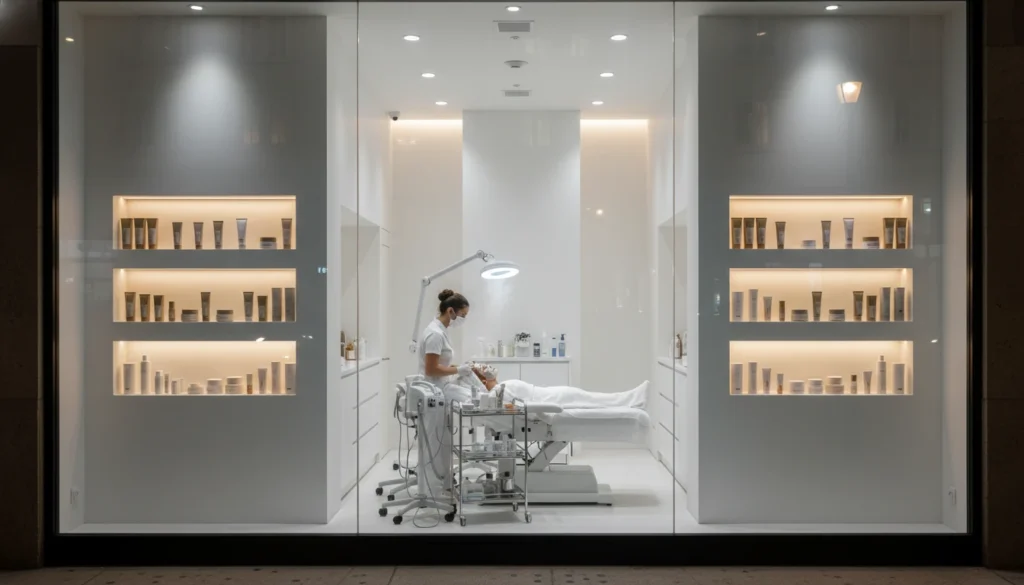
This business idea offers 30-45 minute non-invasive high-tech facials at aesthetic clinics. These include Laser and HydraFacial treatments.
The typical location is shopping malls or office areas selling “Lunchtime Beauty.”
City women want efficient results without long breaks. They prefer regular, affordable tech-facials.
This differs from costly, one-off cosmetic surgeries. The model supports their busy lifestyles.
The legal structure is a “Skin Care Clinic” (non-invasive). This avoids the heavy regulations of a complete plastic surgery hospital.
It eases licensing and compliance.
Idea 6: Holistic Head Spa (Gội Đầu Dưỡng Sinh)
This establishment transforms conventional hair washing into a psycho-wellness retreat at beauty salons. It integrates herbal scalp washing with neck and shoulder massage.
It provides unique beauty and relaxation experiences.
This ranks as a main relaxation measure for office workers. Hanoi and Ho Chi Minh City serve as major areas of popularity.
Head spas also boast high recurrence rates, with many clients visiting weekly.
Staffing requires trained technicians, not medical doctors. Salary expenses stay lower (approximately $300-$500/month).
Nonetheless, quality service proves essential with extensive training in massage techniques.
Idea 7: AI-Powered Personalization (Tech-Beauty)
This feature applies to AI-based skin recognition apps or in-store machines as beauty tech innovations. They diagnose conditions and prescribe specific regimens for skin problems.
Modern consumers crave personalization.
Vietnamese users love data-driven approaches. Presenting them with a “Skin Score” generates much higher conversion rates.
This evidence-based strategy fosters confidence and promotes informed buying.
4. Execution Guide: Legal Entry & Operational Costs
Choosing a business model is not the end when starting a beauty business in Vietnam. Investors must navigate the realities of investing in Vietnam.
This section provides a 2026 roadmap.
Legal Framework: Trading vs. Service
A trading entity (import/retail) requires IRC & ERC (Investment Registration Certificate and Enterprise Registration Certificate) under industry regulations. A mandatory local distributor must register products.
This supports conformity with local regulatory standards.
License concepts like the “Skin Gym” depend on treatment scope. Invasive procedures (needles/lasers) necessitate a licensed medical physician on staff.
Real Estate Benchmarks (2026)
Tier 1 areas like District 1 (HCMC) or Hoan Kiem (Hanoi) cost $80-$150 USD/sqm. These positions prove critical to brand confidence, though with excessive burn rates.
Tier 2 locations, such as District 2/7 (HCMC) or Tay Ho (Hanoi), price at $25-$50 USD/sqm. These locations prove perfect for spas and clinics.
They successfully target expats and the growing middle-class population.
Logistics & Supply Chain
“Treatment” products (Idea 1) and “Green” products (Idea 4) require climate control through cosmetic product distribution. Vietnam’s high humidity causes wastage of vitamin C and Retinol.
Last-mile delivery should offer “Same Day” service. Services like Grab or Ahamove guarantee fast motorbike delivery.
This pace proves critical to compete in the “Shoppertainment” era.
5. Strategic FAQs & Risk Management
Answering frequent investor questions helps solidify business decisions when planning a beauty business in Vietnam. Understanding risks also proves key to succeeding in the Vietnamese market.
Can I own 100% of a Spa or Clinic in Vietnam?
Yes, foreign investors may hold full ownership. Nevertheless, you must show appropriate physical facilities to receive a license.
This involves meeting certain space and equipment requirements.
Idea 1 (Distribution) vs. Idea 5 (Skin Gym): Which has faster ROI?
Distribution delivers quicker cash flow with establishment in about three months. However, margins typically stay lower.
A Skin Gym takes longer to start (6-9 months for setup and licensing) but offers higher customer lifetime value (LTV).
| Criteria | Idea 1: Dermocosmetics Distributor | Idea 5: Skin Gym (High-Tech Facial Bar) |
| Business Type | Product-based (Import & Distribution) | Service-based (Non-invasive clinic) |
| Market Context | “Treatment era” – science-backed skincare demand | Urban demand for fast, result-driven facials |
| Initial Cost Nature | High compliance & registration cost per SKU | High upfront cost for equipment & location |
| Setup Time | ~3 months | 6–9 months |
| Regulatory Complexity | High (Product Notification, labeling, customs) | Medium–High (clinic license, treatment scope) |
| Cash Flow | Fast (product sales) | Slower at start |
| Margin Profile | Lower margins | Higher margins |
| Customer Lifetime Value (LTV) | Lower, transaction-based | Higher, repeat treatments |
| ROI Speed | Faster ROI | Slower ROI, stronger long-term return |
| Scalability | High via the distribution network | Moderate (location-dependent) |
| Key Risk | SKU compliance errors; advertising restrictions | Licensing delays; location burn rate |
Regulatory Risks
Advertising bans prove strict when operating a beauty business in Vietnam. Using terms such as “Cure,” “Treat” or “Medicine” as labels on cosmetic products constitutes a major offense.
This applies to Dermocosmetics (Idea 1) and Green Beauty products (Idea 4) within brand adaptation strategies.
One major risk facing spas is the “Doctor” trap (Idea 6). Staff members cannot wear white coats and stethoscopes without licenses.
Presenting oneself as a medical authority can result in closure.
6. Conclusion: Determining Your Competitive Focus
The 2026 beauty industry favors expertise and efficiency when building a beauty business in Vietnam. Brands need to provide specialized solutions, whether in particular treatments, male grooming, or green products, following market trends in Asia.
Social commerce also proves essential for speed of access.
Do not attempt to become a generalist. Choose one of the seven discussed niches.
Secure a local legal entity early for compliance. Invest in a “Review Army” to create growth in your beauty business in Vietnam.


How to Formulate Cosmetic Products for Beginners
How to Create a Stunning Cosmetic Brand Color Palette for Your Business
7 Powerful Salon Expansion Strategies & Key Performance Metrics
Franchising a Beauty Salon: 7 Powerful Tips for Rapid Growth
Opening Multiple Salon Locations: 6 Expert Tips for Faster Growth
Cosmetic Labeling Requirements Explained (US, EU & Global Standards)